Introduction
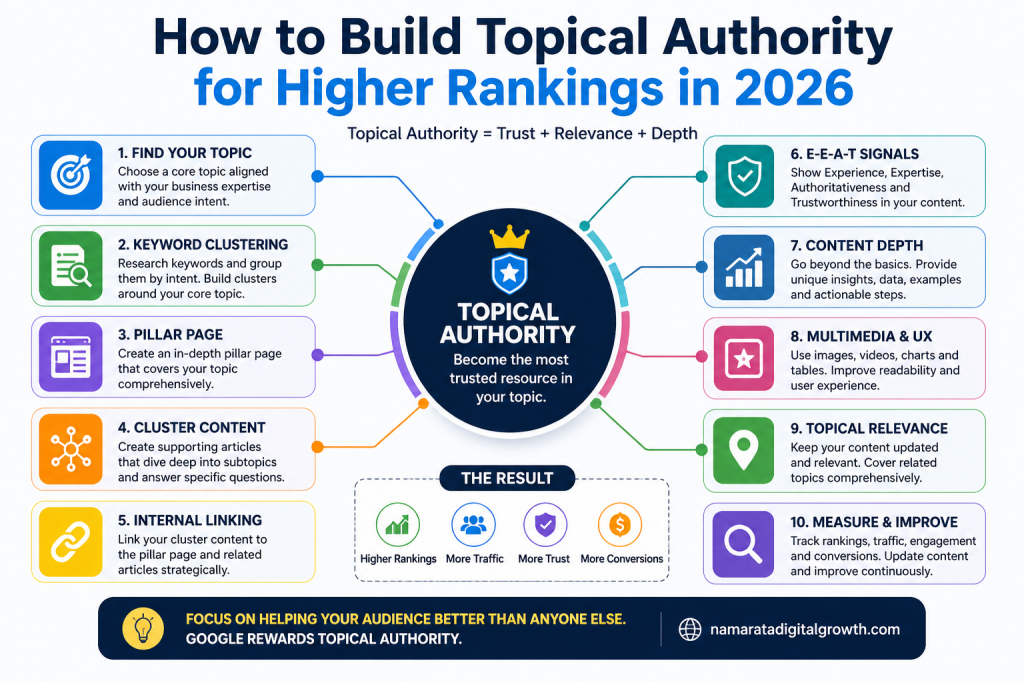
In 2026, ranking on Google is no longer just about using the right keyword on the right page. Search engines now focus much more on trust, expertise, and content depth. This is where topical authority becomes important. Websites that consistently cover a subject in depth are far more likely to rank than websites that publish random, unrelated blog posts.
Topical authority means your website is recognized as a trusted source for a specific subject. Instead of trying to rank one article at a time, businesses now need to build an entire content ecosystem around their niche. Google wants to see expertise, helpful content, strong internal linking, and clear relationships between topics.
This is also important for GEO (Generative Engine Optimization) because AI-powered search engines prefer pulling answers from sources that show strong subject authority. In simple terms, Google ranks pages, but AI selects trusted sources.
For businesses trying to improve SEO performance, building topical authority is one of the strongest long-term strategies for higher rankings and stronger organic traffic.
Why Topical Authority Matters More in 2026
A lot of websites still focus only on individual keywords. They write one blog post, hope it ranks, and then move on to something completely different. That approach is much weaker today.
Google now looks for patterns of expertise.
For example, if a digital marketing website writes only one article about SEO, it may struggle to compete. But if that same site has articles on keyword research, onsite SEO, local SEO, backlinks, Google Ads, and content strategy, Google sees stronger subject authority.
This improves:
- rankings
- crawl efficiency
- user trust
- click-through rate (CTR)
- conversion opportunities
- AI visibility
Topical authority helps search engines understand that your website is not just discussing a topic once—it actually specializes in it.
Pillar Pages and Content Clusters
One of the best ways to build topical authority is through pillar pages and content clusters.
A pillar page is the main guide for a broad topic.
Example:
SEO Best Practices in 2026
Supporting cluster articles may include:
- keyword research strategies
- onsite SEO improvements
- backlink building methods
- local SEO ranking factors
- technical SEO basics
- content optimization strategies
Each supporting article links back to the main pillar page, and the pillar page links back to the cluster content.
This creates strong internal linking and helps Google understand topic relationships.
Instead of isolated content, the website becomes a connected authority system.
Keyword Clustering Instead of Keyword Stuffing
Older SEO strategies focused heavily on repeating the same keyword many times. That no longer works well.
Modern SEO uses keyword clustering.
Keyword clustering means grouping related search terms around one main topic instead of creating separate weak pages for every variation.
Example:
Main topic:
Local SEO
Supporting terms:
- Google Business Profile optimization
- local citations
- map pack rankings
- NAP consistency
- review strategy
- local landing pages
This helps content feel natural while also improving semantic relevance.
Google understands topic relationships much better now. Repeating the same phrase too often can actually weaken readability and trust.
Topical depth beats keyword repetition.
Semantic SEO and Entity Optimization
Google does not rely only on exact-match keywords anymore. It understands concepts, relationships, and entities.
This is called semantic SEO.
For example, an article about keyword research should naturally include related concepts like:
- search intent
- keyword difficulty
- SERP analysis
- conversion rate
- topical authority
- internal linking
- Google Search Console
- Semrush
- Ahrefs
These supporting terms help search engines understand expertise.
Entity SEO focuses on recognized topics, brands, tools, places, and concepts.
For example:
- Google Ads
- GA4
- Google Search Console
- Michigan local businesses
- WordPress SEO
This improves both traditional search rankings and AI-generated answer visibility.
Strong authority comes from subject depth, not exact-match repetition.
Internal Linking Builds Authority Flow
Internal linking is one of the most overlooked parts of topical authority.
It helps:
- distribute authority across pages
- improve crawl efficiency
- keep users engaged longer
- strengthen topic relevance
- support better conversion paths
For example, an article about keyword research should naturally link to:
- onsite SEO best practices
- local SEO strategies
- backlink building methods
- content marketing strategy
This creates a better user experience and helps search engines understand how your content supports a larger topic.
Pages without strong internal linking often lose ranking power because they feel isolated.
Good websites guide users from one useful answer to the next.
E-E-A-T and Trust Signals
Google’s E-E-A-T framework stands for:
- Experience
- Expertise
- Authoritativeness
- Trustworthiness
Topical authority supports all four.
For example, if your website regularly publishes high-quality SEO content with strong references, clear examples, and consistent expertise, trust increases.
Other trust signals include:
- author credibility
- updated content
- reputable references
- strong About pages
- contact information
- real business presence
- customer reviews
People often focus only on keywords and forget trust. Google does not.
Authority grows faster when expertise is supported by credibility.
GEO and AI Search Visibility
Generative Engine Optimization (GEO) is becoming more important because users increasingly get answers from AI-generated search results.
AI systems prefer content that is:
- well structured
- factually strong
- clearly written
- supported by trusted sources
- connected to strong topical authority
This means websites with strong content clusters and clear expertise are more likely to be used as answer sources.
A random article may rank.
A trusted soursource gets cited.
Businesses that build topical authority now will have a major advantage as AI search continues growing.
KPIs That Measure Topical Authority Success
Topical authority should connect to measurable business outcomes.
Important KPIs include:
- organic traffic growth
- ranking improvements across keyword groups
- click-through rate (CTR)
- average session duration
- bounce rate
- returning visitors
- lead generation
- assisted conversions
- AI search visibility
A common mistake is tracking only one keyword.
Topical authority works across clusters, so success should be measured across the entire content ecosystem.
SEO should improve business growth, not just rankings on one page.
Common Mistakes to Avoid
Publishing Random Content
Unrelated blog topics weaken subject authority.
Weak Internal Linking
Pages without connections lose ranking strength.
Thin Content
Short, shallow content rarely builds expertise.
Keyword Stuffing
Repetition hurts readability and trust.
No GEO Strategy
Ignoring AI visibility means missing future search opportunities.
Topical authority requires consistency, not isolated effort.
FAQ
What is topical authority in SEO?
Topical authority means your website is recognized as a trusted source for a specific subject because of strong content depth and expertise.
How do pillar pages help rankings?
They organize broad topics and connect supporting cluster content through internal linking, improving relevance and authority.
Is keyword clustering better than keyword stuffing?
Yes. Keyword clustering improves semantic relevance and readability, while keyword stuffing often hurts performance.
How does GEO relate to topical authority?
AI-powered search engines prefer trusted sources with strong expertise, which makes topical authority important for GEO visibility.
How long does it take to build topical authority?
It depends on competition and consistency, but strong topical authority usually builds over months of strategic content publishing.
References
Google Search Central https://developers.google.com/search
Google Search Console https://search.google.com/search-console
Semrush Blog https://www.semrush.com/blog
Ahrefs Blog https://ahrefs.com/blog
Moz SEO Learning Center https://moz.com/learn/seo
Search Engine Journal https://www.searchenginejournal.com
HubSpot Marketing Blog https://blog.hubspot.com
Backlinko SEO Guides https://backlinko.com
Leave a Reply