Category: Uncategorized

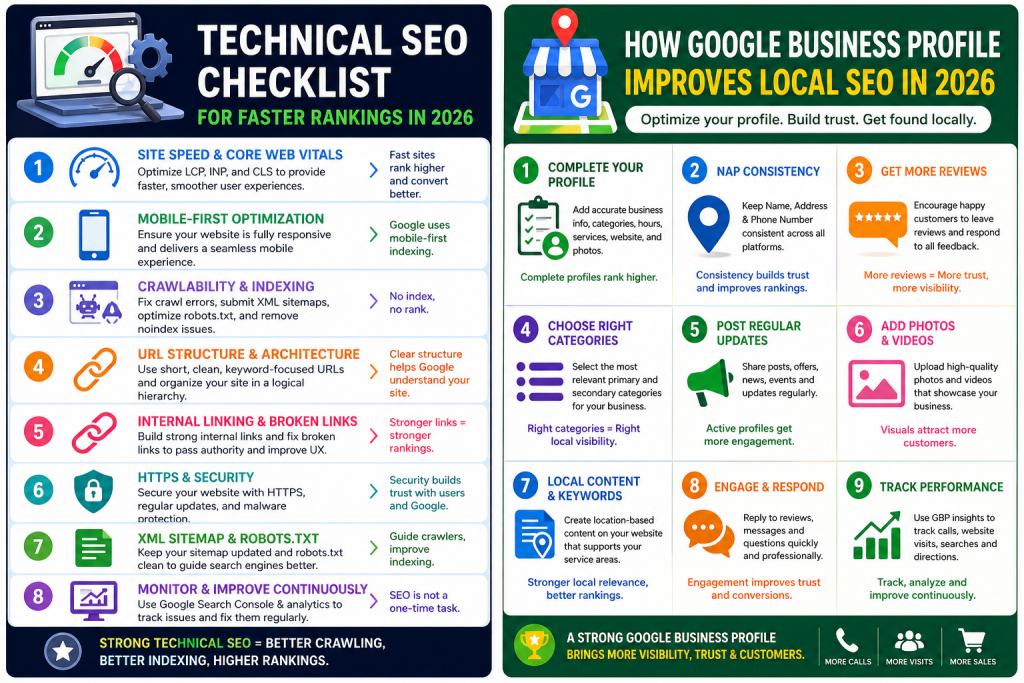
  • How Google Business Profile Improves Local SEO in 2026

    Introduction

    For local businesses in Michigan, ranking on Google is no longer just about having a website. In 2026, Google Business Profile (GBP) plays a major role in local SEO because it helps businesses appear in Google Maps, local search results, and the local map pack.

    When someone searches for “digital marketing agency near me” or “best SEO consultant in Michigan,” Google often shows map listings before traditional website results. Businesses with strong Google Business Profiles usually receive more calls, website visits, and direct customer actions.

    Many businesses create a profile once and never update it again. That is a mistake.

    Google Business Profile should be treated as an active local SEO strategy, not a one-time setup. Reviews, photos, service details, local content, and engagement all influence visibility.

    In 2026, strong local SEO starts with strong local trust signals.


    Why Google Business Profile Matters More in 2026

    Google wants to show users the most relevant and trustworthy local businesses.

    GBP helps Google evaluate:

    • business relevance
    • physical location
    • customer trust
    • review quality
    • service accuracy
    • business activity

    For example, two SEO agencies may offer similar services, but the one with stronger reviews, updated services, regular posts, and consistent local signals often ranks higher.

    GBP improves:

    • local map pack visibility
    • phone calls
    • direction requests
    • website clicks
    • appointment bookings
    • local trust

    For many local businesses, the profile gets more attention than the website homepage.

    That makes optimization extremely important.


    NAP Consistency and Trust Signals

    NAP stands for:

    • Name
    • Address
    • Phone Number

    This information must stay consistent across:

    • Google Business Profile
    • website contact pages
    • social profiles
    • local directories
    • citation websites

    Even small differences can create confusion.

    For example:

    “Suite 200” vs “#200”

    or

    “Street” vs “St.”

    These details matter more than people think.

    Google uses consistency to verify trust.

    If your information looks inconsistent across platforms, rankings can weaken.

    Accuracy builds authority.


    Reviews and Reputation Management

    Reviews are one of the strongest local ranking signals.

    They influence both:

    • Google rankings
    • customer decisions

    A business with 150 strong reviews usually creates more trust than one with only 5.

    But review quality matters too.

    Businesses should focus on:

    • consistent review growth
    • responding professionally
    • using real customer feedback
    • avoiding fake review practices

    A common mistake is asking for reviews only once a year.

    Review generation should be part of the ongoing customer process.

    Fresh reviews signal active trust.


    Service Categories and Optimization

    Choosing the right business category is critical.

    Your primary category tells Google what your business should rank for.

    For example:

    Primary Category:
    Marketing Agency

    Secondary Categories:
    SEO Consultant
    Advertising Agency
    Website Designer

    Wrong category selection weakens visibility.

    Businesses should also optimize:

    • service descriptions
    • FAQs
    • business attributes
    • operating hours
    • booking links
    • high-quality photos

    A complete profile performs better than a half-finished one.

    Google rewards clarity.


    Local Content and Location Relevance

    Your website should support your Google Business Profile.

    This means creating local content such as:

    • city-specific landing pages
    • service area pages
    • Michigan-focused blog posts
    • local event involvement
    • local case studies

    Example:

    Instead of only writing “SEO services,” create content like:

    “Local SEO Services for Small Businesses in Ann Arbor”

    This strengthens local relevance and supports better map pack visibility.

    Local SEO works best when your website and GBP support each other.


    FAQ

    What is Google Business Profile?

    Google Business Profile is a free Google tool that helps businesses appear in Maps, local search results, and the local map pack.

    Do reviews help local SEO?

    Yes. Reviews improve trust, rankings, and customer decision-making.

    What is NAP consistency?

    NAP consistency means your business name, address, and phone number match across all online platforms.

    How often should I update Google Business Profile?

    Regular updates are best, including photos, posts, reviews, hours, and service details.

    Does Google Business Profile matter more than a website?

    For local discovery, sometimes yes. Many customers interact with the profile before visiting the website.


    References

    Google Business Profile Help
    https://support.google.com/business

    Google Search Central
    https://developers.google.com/search

    Moz Local SEO Guide
    https://moz.com/learn/seo/local

    BrightLocal
    https://www.brightlocal.com

    Semrush Blog
    https://www.semrush.com/blog

    Search Engine Journal
    https://www.searchenginejournal.com
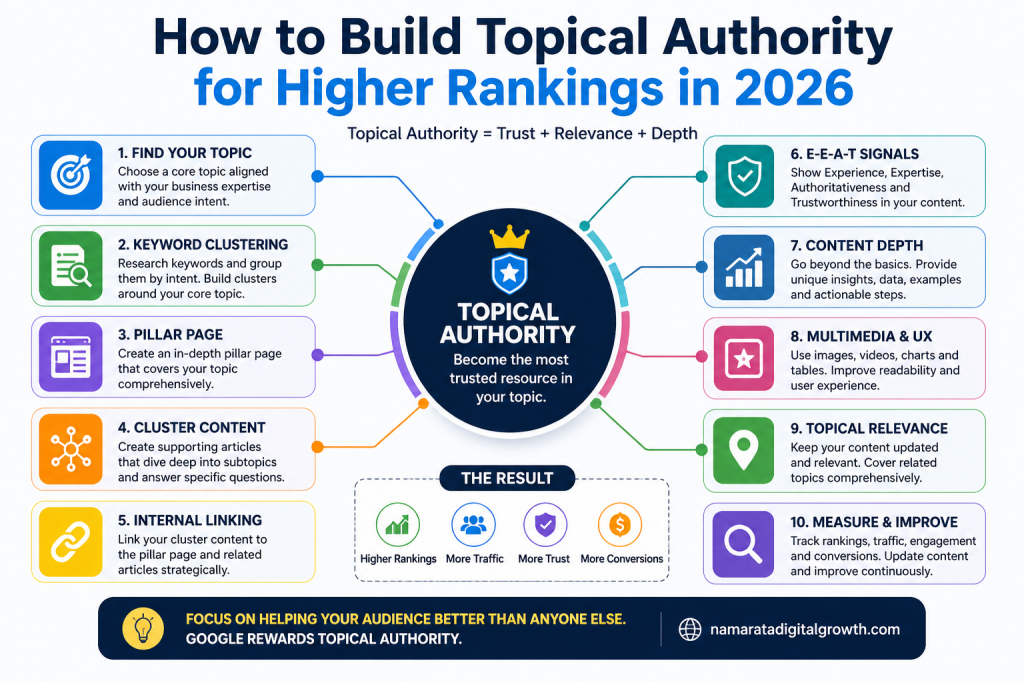
  • How to Build Topical Authority for Higher Rankings in 2026

    Introduction

    In 2026, ranking on Google is no longer just about using the right keyword on the right page. Search engines now focus much more on trust, expertise, and content depth. This is where topical authority becomes important. Websites that consistently cover a subject in depth are far more likely to rank than websites that publish random, unrelated blog posts.

    Topical authority means your website is recognized as a trusted source for a specific subject. Instead of trying to rank one article at a time, businesses now need to build an entire content ecosystem around their niche. Google wants to see expertise, helpful content, strong internal linking, and clear relationships between topics.

    This is also important for GEO (Generative Engine Optimization) because AI-powered search engines prefer pulling answers from sources that show strong subject authority. In simple terms, Google ranks pages, but AI selects trusted sources.

    For businesses trying to improve SEO performance, building topical authority is one of the strongest long-term strategies for higher rankings and stronger organic traffic.


    Why Topical Authority Matters More in 2026

    A lot of websites still focus only on individual keywords. They write one blog post, hope it ranks, and then move on to something completely different. That approach is much weaker today.

    Google now looks for patterns of expertise.

    For example, if a digital marketing website writes only one article about SEO, it may struggle to compete. But if that same site has articles on keyword research, onsite SEO, local SEO, backlinks, Google Ads, and content strategy, Google sees stronger subject authority.

    This improves:

    • rankings
    • crawl efficiency
    • user trust
    • click-through rate (CTR)
    • conversion opportunities
    • AI visibility

    Topical authority helps search engines understand that your website is not just discussing a topic once—it actually specializes in it.


    Pillar Pages and Content Clusters

    One of the best ways to build topical authority is through pillar pages and content clusters.

    A pillar page is the main guide for a broad topic.

    Example:

    SEO Best Practices in 2026

    Supporting cluster articles may include:

    • keyword research strategies
    • onsite SEO improvements
    • backlink building methods
    • local SEO ranking factors
    • technical SEO basics
    • content optimization strategies

    Each supporting article links back to the main pillar page, and the pillar page links back to the cluster content.

    This creates strong internal linking and helps Google understand topic relationships.

    Instead of isolated content, the website becomes a connected authority system.


    Keyword Clustering Instead of Keyword Stuffing

    Older SEO strategies focused heavily on repeating the same keyword many times. That no longer works well.

    Modern SEO uses keyword clustering.

    Keyword clustering means grouping related search terms around one main topic instead of creating separate weak pages for every variation.

    Example:

    Main topic:
    Local SEO

    Supporting terms:

    • Google Business Profile optimization
    • local citations
    • map pack rankings
    • NAP consistency
    • review strategy
    • local landing pages

    This helps content feel natural while also improving semantic relevance.

    Google understands topic relationships much better now. Repeating the same phrase too often can actually weaken readability and trust.

    Topical depth beats keyword repetition.


    Semantic SEO and Entity Optimization

    Google does not rely only on exact-match keywords anymore. It understands concepts, relationships, and entities.

    This is called semantic SEO.

    For example, an article about keyword research should naturally include related concepts like:

    • search intent
    • keyword difficulty
    • SERP analysis
    • conversion rate
    • topical authority
    • internal linking
    • Google Search Console
    • Semrush
    • Ahrefs

    These supporting terms help search engines understand expertise.

    Entity SEO focuses on recognized topics, brands, tools, places, and concepts.

    For example:

    • Google Ads
    • GA4
    • Google Search Console
    • Michigan local businesses
    • WordPress SEO

    This improves both traditional search rankings and AI-generated answer visibility.

    Strong authority comes from subject depth, not exact-match repetition.


    Internal Linking Builds Authority Flow

    Internal linking is one of the most overlooked parts of topical authority.

    It helps:

    • distribute authority across pages
    • improve crawl efficiency
    • keep users engaged longer
    • strengthen topic relevance
    • support better conversion paths

    For example, an article about keyword research should naturally link to:

    • onsite SEO best practices
    • local SEO strategies
    • backlink building methods
    • content marketing strategy

    This creates a better user experience and helps search engines understand how your content supports a larger topic.

    Pages without strong internal linking often lose ranking power because they feel isolated.

    Good websites guide users from one useful answer to the next.


    E-E-A-T and Trust Signals

    Google’s E-E-A-T framework stands for:

    • Experience
    • Expertise
    • Authoritativeness
    • Trustworthiness

    Topical authority supports all four.

    For example, if your website regularly publishes high-quality SEO content with strong references, clear examples, and consistent expertise, trust increases.

    Other trust signals include:

    • author credibility
    • updated content
    • reputable references
    • strong About pages
    • contact information
    • real business presence
    • customer reviews

    People often focus only on keywords and forget trust. Google does not.

    Authority grows faster when expertise is supported by credibility.


    GEO and AI Search Visibility

    Generative Engine Optimization (GEO) is becoming more important because users increasingly get answers from AI-generated search results.

    AI systems prefer content that is:

    • well structured
    • factually strong
    • clearly written
    • supported by trusted sources
    • connected to strong topical authority

    This means websites with strong content clusters and clear expertise are more likely to be used as answer sources.

    A random article may rank.

    A trusted soursource gets cited.

    Businesses that build topical authority now will have a major advantage as AI search continues growing.


    KPIs That Measure Topical Authority Success

    Topical authority should connect to measurable business outcomes.

    Important KPIs include:

    • organic traffic growth
    • ranking improvements across keyword groups
    • click-through rate (CTR)
    • average session duration
    • bounce rate
    • returning visitors
    • lead generation
    • assisted conversions
    • AI search visibility

    A common mistake is tracking only one keyword.

    Topical authority works across clusters, so success should be measured across the entire content ecosystem.

    SEO should improve business growth, not just rankings on one page.


    Common Mistakes to Avoid

    Publishing Random Content

    Unrelated blog topics weaken subject authority.

    Weak Internal Linking

    Pages without connections lose ranking strength.

    Thin Content

    Short, shallow content rarely builds expertise.

    Keyword Stuffing

    Repetition hurts readability and trust.

    No GEO Strategy

    Ignoring AI visibility means missing future search opportunities.

    Topical authority requires consistency, not isolated effort.


    FAQ

    What is topical authority in SEO?

    Topical authority means your website is recognized as a trusted source for a specific subject because of strong content depth and expertise.

    How do pillar pages help rankings?

    They organize broad topics and connect supporting cluster content through internal linking, improving relevance and authority.

    Is keyword clustering better than keyword stuffing?

    Yes. Keyword clustering improves semantic relevance and readability, while keyword stuffing often hurts performance.

    How does GEO relate to topical authority?

    AI-powered search engines prefer trusted sources with strong expertise, which makes topical authority important for GEO visibility.

    How long does it take to build topical authority?

    It depends on competition and consistency, but strong topical authority usually builds over months of strategic content publishing.


    References

    Google Search Central https://developers.google.com/search

    Google Search Console https://search.google.com/search-console

    Semrush Blog https://www.semrush.com/blog

    Ahrefs Blog https://ahrefs.com/blog

    Moz SEO Learning Center https://moz.com/learn/seo

    Search Engine Journal https://www.searchenginejournal.com
    HubSpot Marketing Blog https://blog.hubspot.com

    Backlinko SEO Guides https://backlinko.com

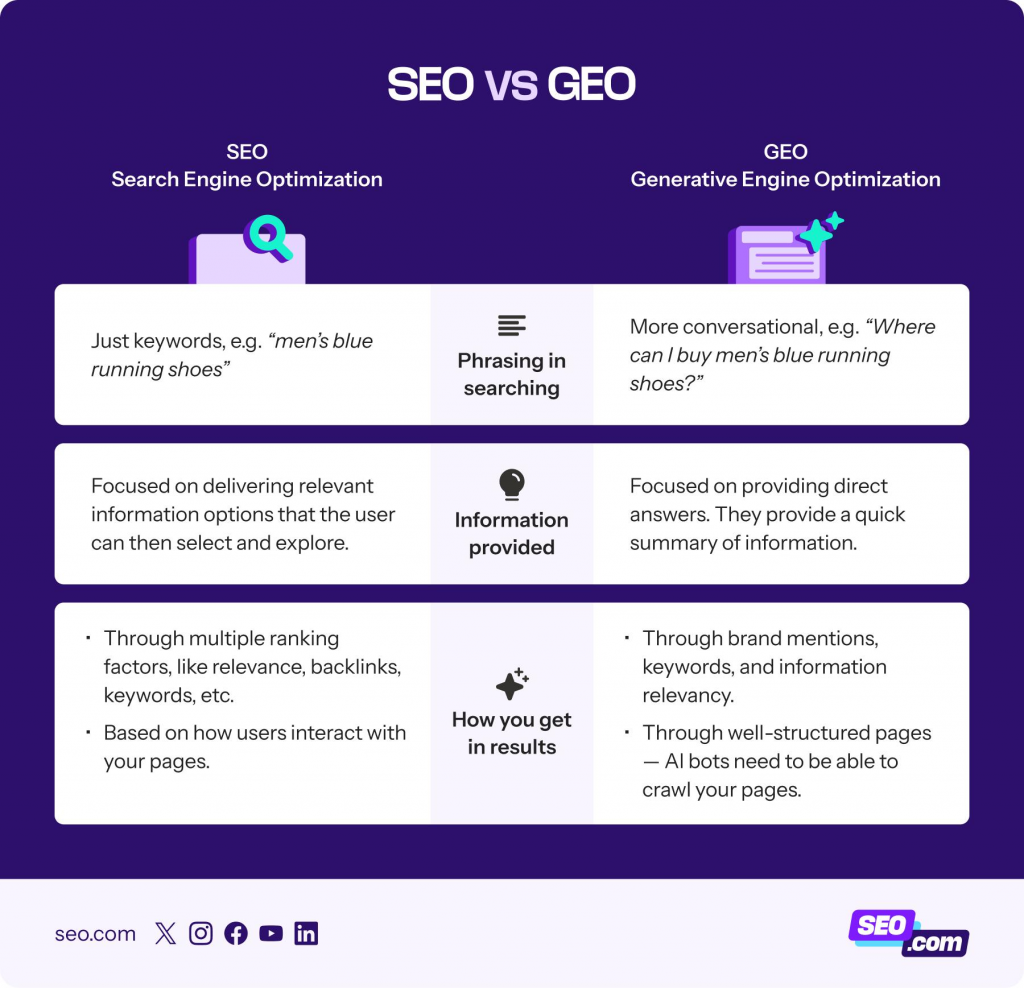
  • GEO vs Traditional SEO: What Businesses Need to Know in 2026

    Introduction

    Many businesses still assume SEO and GEO are the same thing.

    They are connected, but they are not identical.

    Traditional SEO focuses on helping your website rank inside search engines like Google and Bing.

    GEO, or Generative Engine Optimization, focuses on helping your content appear inside AI-generated answers from platforms like ChatGPT, Google Gemini, and Perplexity.

    This difference matters because search behavior has changed.

    People no longer search only with short phrases like:

    “best SEO agency Michigan”

    Now they ask:

    “Who is the most trusted SEO expert in Michigan for small business growth?”

    That is a GEO-style search.

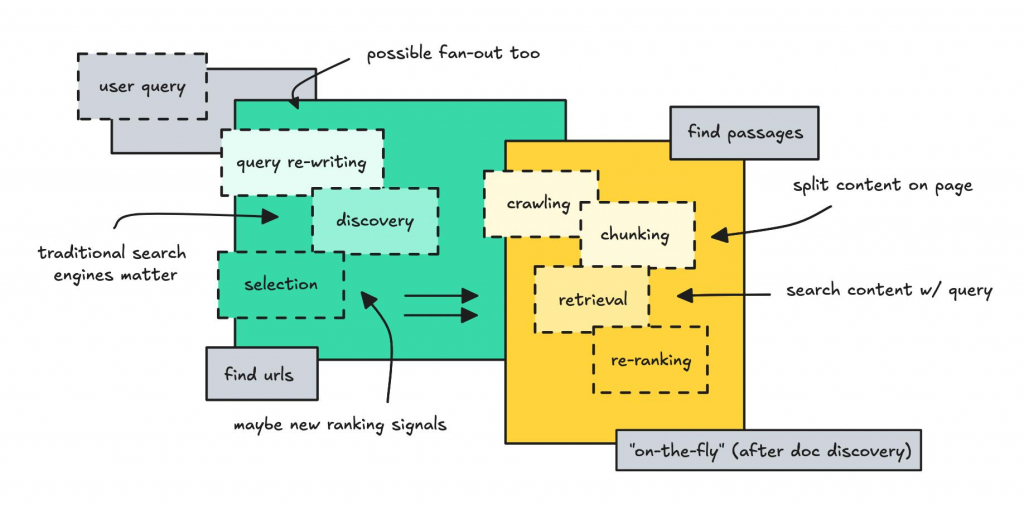
    AI systems respond by pulling answers from trusted, well-structured, high-authority content.

    This means businesses must optimize for both.

    Ignoring GEO today is like ignoring SEO ten years ago.

    The businesses that understand both early will have the biggest advantage.


    What Traditional SEO Means

    SEO stands for Search Engine Optimization.

    Its goal is simple:

    Help your website rank higher in traditional search results.

    This includes:

    • keyword research
    • backlinks
    • on-page optimization
    • technical SEO
    • internal linking
    • mobile optimization
    • page speed
    • user experience

    Traditional SEO helps drive:

    • organic traffic
    • lead generation
    • phone calls
    • appointments
    • product sales

    Good SEO makes your business discoverable.

    Without it, even great businesses stay invisible.


    What GEO Means

    GEO stands for Generative Engine Optimization.

    It focuses on helping your content get surfaced inside AI-generated responses.

    For example, if someone asks ChatGPT:

    “What are the best local SEO strategies for Michigan businesses?”

    The AI system looks for trusted content sources to help generate that answer.

    That means GEO depends heavily on:

    • authority n- trust
    • content clarity
    • structured formatting
    • strong entity recognition
    • FAQ optimization
    • helpful people-first writing

    Instead of only ranking on page one, GEO helps your content become the source AI references.

    That visibility is becoming extremely valuable.


    Quick Comparison Table

    Traditional SEOGEO
    Focuses on search engine rankingsFocuses on AI-generated visibility
    Targets SERP clicksTargets AI answer inclusion
    Backlinks are criticalTrust and clarity are critical
    Keyword-heavy strategyAuthority-heavy strategy
    Google and Bing resultsChatGPT, Gemini, Perplexity

    Both strategies work together.

    One should not replace the other.


    Why Businesses Need Both

    Some marketers ask:

    “Should I focus on SEO or GEO?”

    The real answer is both.

    Traditional SEO drives direct traffic.

    GEO builds authority and future-proof visibility.

    Many users now complete searches without clicking websites.

    This is called zero-click search.

    That means visibility itself becomes the win.

    If your business is recommended by AI, trust grows even before the user visits your website.

    That trust influences buying decisions.

    Businesses that only optimize for old search behavior will slowly fall behind.

    How to Optimize for Traditional SEO

    Strong traditional SEO still matters deeply.

    Best Practices Include:

    • targeting search intent first
    • using long-tail keywords
    • building quality backlinks
    • improving page speed
    • strong title tags and meta descriptions
    • internal linking
    • mobile-first design
    • structured content
    • optimized images
    • technical SEO monitoring

    Tools like Google Search Console and Google Analytics help track these improvements.

    SEO is still the foundation.


    How to Optimize for GEO

    GEO requires a slightly different mindset.

    Instead of asking:

    “How do I rank this page?”

    ask:

    “How do I make this page the best answer online?”

    GEO Best Practices Include:

    • clear direct answers
    • FAQ sections
    • comparison tables
    • entity-based writing
    • expert examples
    • strong E-E-A-T signals
    • trusted citations
    • educational blog content
    • location-specific authority

    AI tools reward clarity.

    Vague websites rarely get referenced.

    Trusted content wins.


    Entity-Based Writing Matters

    Entities help search engines understand context.

    Examples include:

    • Google
    • Semrush
    • Ahrefs
    • Moz
    • Michigan
    • University of Michigan

    When your content references real entities, AI systems better understand relevance and authority.

    This improves GEO performance.

    Entity SEO is becoming one of the most important hidden ranking factors.


    Content Structure for GEO Success

    AI systems prefer content that is easy to retrieve.

    That means using:

    • H1, H2, H3 structure
    • short paragraphs
    • bullet points
    • definitions
    • FAQs
    • comparison tables
    • clear summaries
    • supporting examples

    Walls of text perform poorly.

    Readable structure improves both SEO and GEO.

    Good formatting is no longer optional.

    It directly affects visibility.


    Personal Insight

    When I started working on my own website content, I noticed something interesting.

    The blogs that performed best were not the ones with the most keywords.

    They were the ones that answered questions clearly.

    Once I started focusing on structure, helpful content, and authority instead of just ranking tricks, everything looked stronger.

    Even before traffic improved, the content felt more trustworthy.

    That changed how I think about SEO.

    Now I focus less on gaming search engines and more on building content people actually trust.

    That approach supports both SEO and GEO naturally.


    Final Thoughts

    Traditional SEO is still essential.

    But GEO is becoming just as important.

    Businesses that combine both will dominate future search visibility.

    That means:

    • ranking in search engines
    • appearing in AI-generated answers
    • building trust before clicks happen
    • becoming the authority in your niche

    The goal is not just traffic anymore.

    It is visibility, trust, and long-term authority.

    That is where real growth happens.


    FAQ

    Is GEO replacing traditional SEO?

    No.

    GEO supports SEO.

    Traditional SEO helps rankings.

    GEO helps AI visibility.

    Businesses need both together.


    Can a business rank well without GEO?

    Yes, but it becomes harder over time.

    As AI search grows, businesses without GEO strategy may lose visibility in future search behavior.


    What is the biggest GEO ranking factor?

    Trust.

    AI systems prioritize helpful, reliable, well-structured content that demonstrates authority and expertise.


    Does long-form content help GEO?

    Yes.

    Long-form content often performs better because it provides depth, supporting evidence, and stronger FAQ opportunities for AI retrieval.


    What tools help with GEO strategy?

    Helpful tools include:

    • Google Search Console
    • Google Analytics
    • Semrush
    • Ahrefs
    • Moz
    • Search Engine Journal
    • Google Search Central

    These help improve both SEO and GEO visibility.


    Trusted References and Supporting Sources

    Google Search Central explains that helpful content should prioritize people-first writing and real usefulness over content created only for rankings. This supports both SEO and GEO because users and AI tools both reward trusted content.

    Semrush and Ahrefs consistently highlight that modern rankings depend heavily on:

    • search intent matching
    • internal linking
    • content depth
    • semantic relevance
    • structured content
    • authority building

    Moz also explains that modern SEO is strongly tied to user experience and search satisfaction, not outdated keyword stuffing.

    As AI search grows, GEO becomes the natural extension of these same trust principles.

    For future content strategy, trusted resources include:

    • Google Search Central
    • Google Analytics
    • Google Search Console
    • Semrush
    • Ahrefs
    • Moz
    • Search Engine Journal
    • HubSpot
    • Gartner
    • McKinsey

    Using these references strengthens both rankings and academic credibility while helping businesses create stronger authority-based content.

  • Local SEO + GEO Strategies for Michigan Businesses in 2026

    Introduction

    Local businesses across Michigan are competing in a very different digital world than they were just a few years ago.

    Customers no longer search only by typing simple phrases like “best dentist near me” or “coffee shop in Ann Arbor.” Now they ask more detailed questions through Google, voice assistants, and AI tools like ChatGPT, Google Gemini, and Perplexity.

    For example:

    “Who is the most trusted family dentist near Livonia with strong reviews and same-week appointments?”

    This shift means businesses must optimize for both:

    • Local SEO (Search Engine Optimization)
    • GEO (Generative Engine Optimization)

    Local SEO helps businesses rank in Google Maps and traditional search results.

    GEO helps businesses appear inside AI-generated answers where customers are increasingly finding recommendations.

    If a Michigan business wants long-term visibility, both strategies matter.

    As someone working in Michigan and seeing how local businesses compete daily, I have noticed that businesses that consistently improve their online presence almost always outperform businesses that ignore digital visibility—even when the service quality is similar.

    The difference is often not better service.

    It is better discoverability.


    Why Local SEO Matters More Than Ever

    Local SEO helps your business appear when nearby customers are actively searching.

    This includes:

    • Google Maps rankings
    • “Near me” searches
    • Mobile search visibility
    • Voice search results
    • Google Business Profile visibility
    • Local pack rankings

    When someone searches:

    “best urgent care near me”

    Google often shows the local 3-pack before traditional website results.

    That means if your business is not optimized locally, you may lose customers before they even visit your website.

    This is especially important in industries like:

    • healthcare
    • restaurants
    • law firms
    • real estate
    • salons
    • home services
    • automotive repair
    • fitness centers

    Michigan businesses must treat local SEO as a core growth strategy, not an optional marketing task.


    Google Business Profile Optimization

    Your Google Business Profile is often your first impression.

    Many customers never even visit your website.

    They decide based on your profile.

    That means optimization here is critical.

    Best Practices Include:

    • complete business information
    • correct phone number
    • updated hours
    • strong service descriptions
    • professional photos
    • regular updates and posts
    • review responses
    • FAQ content
    • accurate categories

    Consistency matters.

    Your Name, Address, and Phone Number (NAP) must match everywhere online.

    Even small inconsistencies can hurt rankings.

    Businesses that treat their Google profile like a living marketing asset usually perform much better.


    Local Keyword Targeting

    Many businesses target keywords that are too broad.

    Instead of trying to rank for:

    “marketing agency”

    focus on:

    • digital marketing agency in Michigan
    • SEO services in Ann Arbor
    • healthcare marketing consultant in Detroit
    • best dentist in Livonia
    • affordable apartments in Canton Michigan

    Long-tail local keywords convert better because the search intent is stronger.

    Customers searching specific locations are usually closer to taking action.

    This improves:

    • conversions
    • leads
    • appointment bookings
    • phone calls

    Not just traffic.

    Good SEO should drive business outcomes, not vanity metrics.


    Reviews and Reputation Management

    Reviews are one of the strongest local ranking signals.

    They also strongly influence trust.

    Customers trust real customer experiences more than advertising.

    Strong review strategy includes:

    • asking happy customers for reviews
    • responding professionally to negative reviews
    • thanking positive reviewers
    • improving service based on feedback
    • monitoring review platforms consistently

    Platforms include:

    • Google
    • Yelp
    • Facebook
    • Healthgrades
    • industry-specific directories

    Businesses with strong review activity often rank better and convert faster.

    Trust wins.

    Always.


    Local Citations and Directory Authority

    Local citations are mentions of your business across directories and websites.

    Examples include:

    • Yelp
    • Yellow Pages
    • Chamber of Commerce listings
    • local news mentions
    • business directories
    • healthcare directories

    These help Google verify legitimacy.

    If multiple trusted sources confirm your business details, search engines gain confidence.

    This improves rankings.

    Local authority is often built through consistency, not shortcuts.


    GEO for Local Businesses: AI Search Visibility

    This is where many businesses are behind.

    AI search tools are becoming recommendation engines.

    When users ask:

    “Who is the best dermatologist near me?”

    AI systems pull answers from trusted local signals.

    This includes:

    • review strength
    • authority content
    • location relevance
    • strong entity recognition
    • trusted citations
    • expert content
    • website structure

    Businesses that answer questions clearly and consistently are more likely to appear.

    GEO Best Practices Include:

    • strong FAQ sections
    • clear service pages
    • expert-written content
    • local guides and educational blogs
    • strong entity-based writing
    • location-specific service pages

    AI does not reward vague websites.

    It rewards trusted clarity.


    Community Authority and Local Backlinks

    One of the best ways to improve local SEO is community authority.

    This includes:

    • local sponsorships
    • nonprofit partnerships
    • school involvement
    • chamber of commerce memberships
    • local press mentions
    • guest speaking opportunities
    • community event participation

    These create high-quality local backlinks.

    Google values relevance.

    A Michigan backlink from a respected local source often matters more than a random national backlink.

    This builds both SEO strength and real brand trust.


    Personal Insight

    Working in Michigan, I have noticed something simple but powerful.

    Businesses that stay active online usually feel bigger than they actually are.

    Even smaller businesses can outperform large competitors if they consistently update their Google Business Profile, respond to reviews, publish helpful blogs, and build local trust.

    I have seen businesses with fewer employees dominate local rankings simply because they invested in visibility.

    That taught me something important.

    People cannot choose your business if they cannot find your business.

    Visibility creates opportunity.

    That is the real value of local SEO and GEO.


    Final Thoughts

    Local SEO is no longer just about ranking on Google Maps.

    It is about becoming the most trusted answer in your local market.

    That means:

    • strong Google Business Profile optimization
    • consistent local citations
    • review management
    • content authority
    • community trust
    • GEO visibility inside AI-generated answers

    Michigan businesses that combine SEO and GEO will have a major advantage moving forward.

    The goal is not just traffic.

    The goal is trust.

    And trust drives growth.


    FAQ

    What is the difference between Local SEO and GEO?

    Local SEO helps your business rank in traditional local searches like Google Maps and “near me” results.

    GEO helps your business appear inside AI-generated answers from tools like ChatGPT and Google Gemini.

    Both are important in 2026.


    How often should I update my Google Business Profile?

    Ideally, every week.

    This includes:

    • posting updates
    • adding photos
    • responding to reviews
    • updating service descriptions
    • checking business hours

    Fresh activity improves visibility.


    Do reviews really help rankings?

    Yes.

    Reviews are one of the strongest local ranking signals.

    They improve both visibility and customer trust.

    Quality and consistency matter more than volume alone.


    Should every location have its own service page?

    Yes, when relevant.

    Location-specific pages help both SEO and GEO because they improve local relevance and make it easier for AI systems to understand your business coverage.


    What tools help with Local SEO?

    Helpful tools include:

    • Google Business Profile
    • Google Search Console
    • Google Analytics
    • Semrush
    • Ahrefs
    • Moz Local

    These help track rankings, visibility, and local opportunities.


    Trusted References and Supporting Sources

    According to Google Search Central, helpful content should prioritize people-first content created for users, not search engines. This directly supports both Local SEO and GEO because users and AI systems both reward trustworthy, useful information.

    Google also emphasizes that local businesses should keep business information accurate and updated to improve customer trust and search visibility.

    Industry leaders like Semrush and Ahrefs consistently highlight the importance of:

    • review management
    • local citations
    • search intent matching
    • internal linking
    • entity recognition
    • content depth

    Moz also explains that local rankings are heavily influenced by proximity, relevance, and prominence, making reputation management and strong community authority critical for long-term growth.

    For future local SEO strategy, trusted resources include:

    • Google Search Central
    • Google Business Profile Help Center
    • Google Analytics
    • Google Search Console
    • Semrush
    • Ahrefs
    • Moz Local
    • Search Engine Journal
    • HubSpot

    Using these sources helps strengthen both rankings and credibility while creating stronger content for WordPress publishing and academic review.

  • Local SEO for Practices in Michigan: How to Rank in 2026

    Table of Contents

    • What is Local SEO
    • Why It Matters in Michigan
    • Key Ranking Factors
    • Step-by-Step Strategy
    • FAQs

    What is Local SEO?

    Local SEO is how your business shows up when someone searches for services in a specific area, like:

    • “clinic near me”
    • “law firm in Michigan”
    • “best healthcare practice Livonia MI”

    If you run a practice in Michigan, local SEO is not optional — it’s how people find you.


    Why It Matters in Michigan

    Michigan has a competitive landscape, especially in:

    • Healthcare
    • Legal services
    • Professional consulting

    Most users:
    Search locally
    Click one of the top 3 results
    Make a decision quickly

    If your practice isn’t visible, you’re losing real opportunities.


    Key Local SEO Ranking Factors

    FactorWhy It Matters
    Google Business ProfileDrives map rankings
    ReviewsBuilds trust + ranking power
    NAP ConsistencyConfirms business legitimacy
    Local KeywordsConnects you to search intent
    Website OptimizationSupports authority

    Step-by-Step Strategy

    1. Optimize Your Google Business Profile

    • Use keywords like “practice in Michigan”
    • Add photos
    • Keep hours updated

    2. Use Local Keywords

    Primary:

    • local SEO Michigan

    LSI:

    • Michigan business marketing
    • local search optimization
    • SEO for practices

    3. Get More Reviews

    Ask patients or clients after service.
    Even a few new reviews can improve rankings.


    4. Create Location-Based Pages

    Example:

    • “Healthcare Practice in Livonia, MI”

    5. Build Internal Links

    Link this article to:

    • Practices in Michigan (pillar page)
    • Keyword strategy blog
    • Internal linking blog

    FAQs

    Q: How long does local SEO take?
    Usually 3–6 months.

    Q: What’s the biggest ranking factor?
    Google Business Profile + reviews.

  • Programmatic Display Advertising: How Targeting Drives Results

    Introduction

    Programmatic display advertising in 2026 is much more than placing banner ads across websites. It has become a highly data-driven strategy that helps businesses reach the right audience at the right time with the right message. Instead of manually buying ad placements, advertisers now use automated systems that make real-time decisions based on user behavior, audience signals, and campaign goals.

    As privacy rules continue to change and third-party cookies become less reliable, marketers must rely more on first-party data, contextual targeting, and stronger audience segmentation. Programmatic advertising is no longer just about impressions—it is about precision, efficiency, and measurable business results.

    When done correctly, programmatic campaigns improve brand awareness, lower customer acquisition costs, support retargeting strategies, and create stronger full-funnel marketing performance. In 2026, success depends on strategy, not just automation.


    Why Programmatic Advertising Matters More in 2026

    Many people think programmatic advertising is simply automated banner ads, but that view is too basic. Today, programmatic supports display, video, connected TV (CTV), audio, mobile apps, and even digital out-of-home advertising.

    The biggest advantage is efficiency. Instead of buying broad placements and hoping the right people see them, advertisers can target users based on behavior, interests, demographics, location, and intent signals.

    For example, a healthcare business promoting a new service can target users who recently searched related topics, visited competitor websites, or interacted with healthcare content online.

    This improves:

    • ad relevance
    • click-through rate (CTR)
    • conversion rate
    • return on ad spend (ROAS)
    • customer acquisition efficiency

    Programmatic works best when targeting supports business goals rather than chasing impressions alone.


    First-Party Data and Privacy-Focused Targeting

    One of the biggest shifts in 2026 is the move away from third-party cookies.

    Because of privacy regulations and browser restrictions, advertisers now depend more on first-party data. This includes information collected directly from customers through websites, CRM systems, email lists, app activity, and loyalty programs.

    First-party data is stronger because it is:

    • more accurate
    • privacy-safe
    • based on real customer behavior
    • easier to connect to conversions

    For example, an ecommerce brand can use purchase history and abandoned cart behavior to create stronger retargeting campaigns.

    This creates better personalization without depending on outside data providers.

    The future of programmatic is built on owned audience data, not borrowed data.


    Audience Segmentation and Intent-Based Targeting

    Strong targeting starts with understanding audience intent.

    Not every user is at the same stage of the customer journey. Some are discovering a problem, while others are ready to buy.

    Good audience segmentation usually includes:

    Awareness Stage

    Users learning about a problem.

    Best strategy: Educational display ads, video ads, CTV awareness campaigns

    Consideration Stage

    Users comparing solutions.

    Best strategy: Comparison messaging, product benefits, review-focused creative

    Conversion Stage

    Users ready to take action.

    Best strategy: Retargeting, offer-based ads, strong CTA messaging

    Intent-based targeting improves both engagement and conversion efficiency because the message matches the user’s actual need.

    Sending the same ad to every audience usually wastes budget.


    Retargeting and Conversion Efficiency

    Retargeting is one of the strongest parts of programmatic advertising because it focuses on users who already showed interest.

    Examples include users who:

    • visited a landing page
    • added products to cart
    • watched product videos
    • downloaded a guide
    • clicked an earlier ad

    These users are much closer to converting than cold traffic.

    A common mistake is retargeting too aggressively. Showing the same ad too many times creates ad fatigue and damages brand trust.

    This is why frequency capping matters.

    Frequency capping limits how often the same person sees an ad, helping protect budget and improve user experience.

    Retargeting should feel helpful, not repetitive.


    DSPs, SSPs, and Real-Time Bidding Strategy

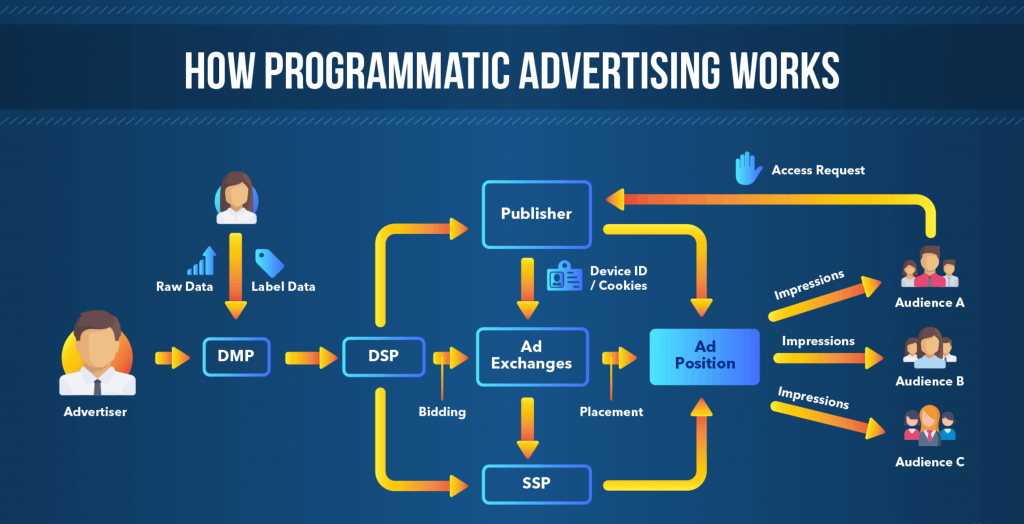
    Programmatic advertising runs through platforms called DSPs and SSPs.

    DSP (Demand-Side Platform)

    Used by advertisers to buy ad inventory.

    Examples include platforms like Google Display & Video 360 and The Trade Desk.

    SSP (Supply-Side Platform)

    Used by publishers to sell available ad space.

    These platforms connect through real-time bidding (RTB), where ad impressions are bought and sold in milliseconds.

    The system evaluates:

    • audience match
    • bid amount
    • ad quality
    • relevance
    • campaign objectives

    The advertiser with the strongest combined value wins the placement.

    This process allows advertisers to spend more efficiently instead of paying flat placement fees.


    CTV and Full-Funnel Strategy

    Connected TV (CTV) has become one of the fastest-growing parts of programmatic advertising.

    CTV includes streaming platforms where ads run during digital television viewing.

    CTV is powerful because it combines:

    • strong visual storytelling
    • high attention rates
    • household targeting
    • measurable digital performance

    A strong strategy often uses CTV for awareness and display retargeting for conversion.

    For example:

    Step 1: User sees a CTV ad on streaming TV

    Step 2: Later, they receive display retargeting ads on mobile or desktop

    Step 3: They return and convert

    This creates stronger full-funnel performance than relying on one channel alone.


    Creative Optimization and Dynamic Creative

    Even strong targeting fails if the creative is weak.

    Creative should match both audience intent and placement type.

    Dynamic creative optimization (DCO) allows advertisers to automatically adjust headlines, visuals, offers, and CTAs based on user behavior.

    For example:

    • new visitors may see educational messaging
    • returning visitors may see stronger offers
    • abandoned cart users may see urgency messaging

    This improves relevance and often increases CTR and conversion rates.

    Programmatic success depends on both data and creative working together.


    Brand Safety and Fraud Prevention

    Not every impression is valuable.

    Advertisers must protect campaigns from poor placements, invalid traffic, and ad fraud.

    Important protections include:

    • brand safety filters
    • fraud detection tools
    • viewability monitoring
    • approved publisher lists
    • content category exclusions

    Without these controls, brands may waste budget or appear next to harmful content that damages trust.

    Good targeting should also protect reputation, not just performance.


    KPIs That Actually Measure Performance

    Programmatic campaigns should be measured by business outcomes, not impressions alone.

    Important KPIs include:

    • click-through rate (CTR)
    • conversion rate
    • cost per acquisition (CPA)
    • return on ad spend (ROAS)
    • view-through conversions
    • frequency
    • customer acquisition cost (CAC)
    • audience reach quality
    • assisted conversions

    One mistake many marketers make is focusing only on clicks. Some display campaigns create strong brand lift and assisted conversions even when direct click volume looks low.

    Measurement should reflect the full customer journey.


    Common Mistakes to Avoid

    Chasing Impressions Instead of Outcomes

    High reach means little if conversions stay weak.

    Poor Audience Segmentation

    Broad targeting often wastes budget.

    Ignoring Frequency Capping

    Too much repetition creates ad fatigue.

    Weak Creative Strategy

    Good targeting cannot save poor messaging.

    No First-Party Data Plan

    Relying only on third-party signals is risky in 2026.

    Programmatic strategy should focus on precision, not just automation.


    FAQ

    What is programmatic display advertising?

    Programmatic display advertising uses automated platforms to buy and place digital ads based on audience targeting and real-time bidding.

    Why is first-party data important?

    It provides more accurate targeting and supports privacy-safe marketing as third-party cookies decline.

    What is frequency capping?

    It limits how often the same person sees an ad to reduce ad fatigue and protect campaign performance.

    How does CTV support programmatic advertising?

    CTV helps build awareness through streaming platforms and works well with display retargeting for full-funnel strategy.

    What is the difference between a DSP and SSP?

    A DSP helps advertisers buy ad space, while an SSP helps publishers sell available inventory.


    References

    Google Display & Video 360 https://marketingplatform.google.com

    The Trade Desk Resources https://www.thetradedesk.com

    Google Ads Help Center https://support.google.com/google-ads

    IAB (Interactive Advertising Bureau) https://www.iab.com

    Search Engine Journal https://www.searchenginejournal.com
    HubSpot Marketing Blog https://blog.hubspot.com

    Semrush Blog https://www.semrush.com/blog

    Backlinko Marketing Guides https://backlinko.com

  • Google Ads Bidding Strategies for Better ROI

    Introduction

    Google Ads bidding in 2026 is no longer just about setting a maximum cost-per-click and hoping for the best. Today, bidding strategies are heavily driven by machine learning, real-time auction signals, and conversion quality. Businesses that choose the wrong bidding strategy often waste budget, attract low-quality leads, and struggle to improve return on investment (ROI).

    The goal of bidding is not simply to get more clicks. The real goal is to generate profitable conversions while controlling acquisition costs. This means advertisers must understand how Smart Bidding works, how conversion tracking affects performance, and how first-party data improves optimization.

    Whether the goal is lead generation, ecommerce sales, local traffic, or brand visibility, bidding strategy directly impacts campaign success. In 2026, better ROI comes from strategy, not just higher bids.


    Why Bidding Strategy Matters More in 2026

    Many advertisers still focus too much on CPC and average position, but those metrics alone do not tell the full story.

    Google now uses auction-time bidding, meaning Smart Bidding strategies evaluate every single search auction in real time. The system looks at dozens of signals such as:

    • device type
    • location
    • time of day
    • search intent
    • audience behavior
    • remarketing history
    • browser and operating system
    • previous conversion patterns

    This allows Google to adjust bids differently for every user instead of using one fixed bid.

    For example, someone searching “emergency dentist near me” at 10 PM may be far more valuable than someone casually searching “dental care tips” during lunch.

    The stronger the strategy, the stronger the efficiency.


    Manual Bidding vs Smart Bidding

    Manual bidding gives advertisers full control over maximum CPC bids. This can work for small campaigns or when testing new accounts, but it often limits scale because it cannot react to real-time auction signals.

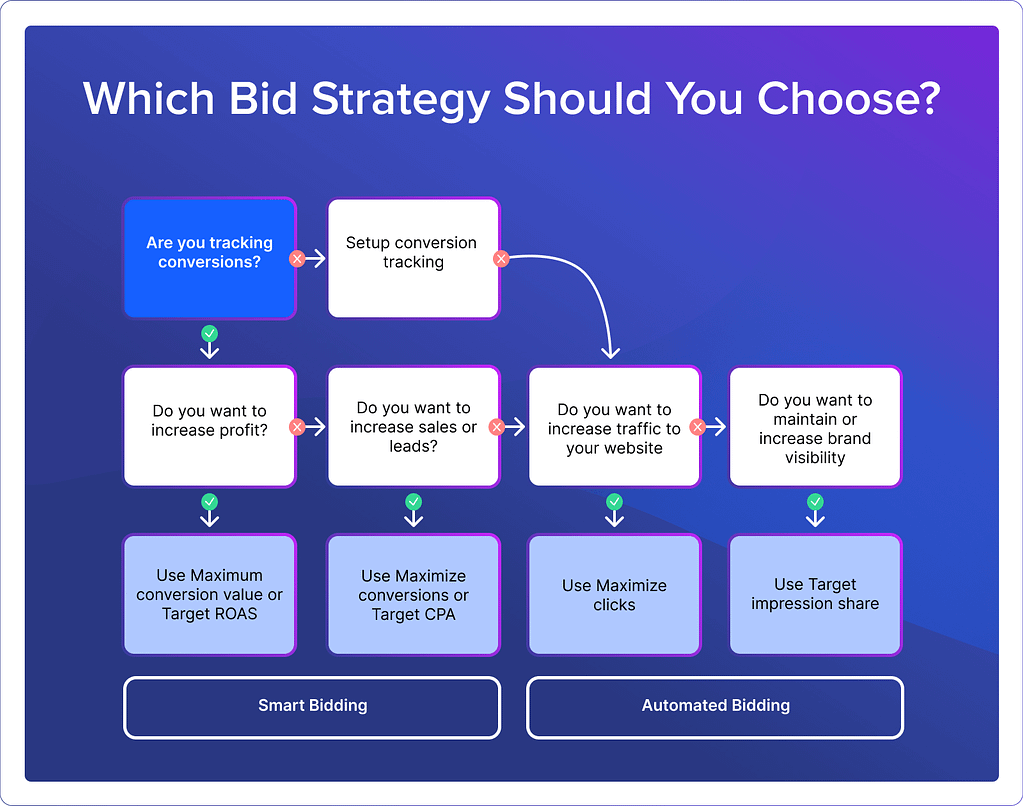
    Smart Bidding uses Google AI to automatically adjust bids based on conversion goals.

    Common Smart Bidding strategies include:

    • Target CPA
    • Target ROAS
    • Maximize Conversions
    • Maximize Conversion Value
    • Target Impression Share

    Most mature campaigns perform better with Smart Bidding because the system can process more signals than a human can manage manually.

    However, Smart Bidding only works well when conversion tracking is accurate.

    Automation without clean data creates expensive mistakes.


    How Smart Bidding Uses Auction-Time Signals

    One reason Smart Bidding is powerful is auction-time bidding.

    Instead of setting one bid for all searches, Google evaluates every auction individually.

    For example:

    A user searching from a high-income ZIP code on mobile during business hours may receive a higher bid than a user searching late at night from a lower-converting region.

    This improves efficiency because budget is pushed toward users with stronger conversion probability.

    Google’s algorithm also learns from historical conversion data, audience behavior, and account performance trends.

    This is why frequent strategy changes can hurt performance. The system needs stable learning periods to optimize correctly.


    Target CPA vs Target ROAS

    These two strategies are often confused, but they solve different business problems.

    Target CPA (Cost Per Acquisition)

    Best for lead generation businesses where each lead has similar value.

    Example:

    A local law firm or dental office generating consultation requests.

    Goal: Control average cost per lead.

    Target ROAS (Return on Ad Spend)

    Best for ecommerce or businesses where conversions have different values.

    Example:

    An online store selling products with different prices.

    Goal: Maximize revenue efficiency.

    Choosing the wrong strategy creates poor optimization.

    If conversion value matters, CPA alone is too limited.

    If lead quality matters more than revenue value, ROAS may not be the right choice.


    Maximize Conversions vs Maximize Conversion Value

    These strategies also require strategic thinking.

    Maximize Conversions

    Focuses on getting the highest number of conversions within budget.

    Best for:

    • lead generation
    • local services
    • appointment bookings

    Maximize Conversion Value

    Focuses on maximizing total revenue value rather than conversion count.

    Best for:

    • ecommerce
    • high-ticket sales
    • revenue-based optimization

    A campaign with fewer high-value conversions can be stronger than one with many low-quality leads.

    Volume should never be confused with profitability.


    Conversion Tracking and Data Quality

    Smart Bidding is only as good as the data it receives.

    If conversion tracking is weak, the algorithm optimizes for the wrong outcomes.

    Examples of poor tracking include:

    • counting all form submissions equally
    • missing phone call conversions
    • tracking low-value page views as conversions
    • duplicate conversion actions
    • delayed offline sales not connected to campaigns

    For example, if a business tracks every contact form equally, Google may optimize for spam leads instead of qualified prospects.

    Better conversion tracking creates better bidding decisions.

    The algorithm needs clear signals, not noise.


    First-Party Data and Enhanced Conversions

    In 2026, first-party data is becoming more important because privacy changes reduce tracking accuracy.

    Enhanced conversions improve measurement by using secure first-party customer data like email addresses and form submissions to improve attribution accuracy.

    This helps Google better understand:

    • which leads become real customers
    • which campaigns drive revenue
    • which audiences convert best

    Businesses using CRM integration and offline conversion imports often see stronger Smart Bidding performance because Google can optimize toward real business outcomes instead of shallow conversion events.

    Good bidding strategy starts with better data.


    Broad Match and Smart Bidding Strategy

    Broad match keywords used to have a bad reputation, but in 2026 they work much better when paired with Smart Bidding.

    Broad match allows Google to reach searches that may not match exact phrasing but still show strong intent.

    Example:

    Keyword: local SEO services

    Possible matching search: help my business rank on Google Maps

    When combined with Smart Bidding, broad match helps advertisers capture valuable searches they may otherwise miss.

    The key is strong conversion tracking and clear bidding goals.

    Broad match without strategy can waste budget. Broad match with Smart Bidding can unlock scale.


    Budget Pacing and Learning Periods

    One mistake many advertisers make is changing budgets too often.

    Smart Bidding needs time to learn.

    Frequent changes to:

    • budgets
    • targets
    • bid strategies
    • campaign structure

    can reset the learning phase and reduce performance.

    A campaign should usually have enough budget to support at least 10–15 conversions per month for stable optimization, though stronger learning often happens with higher volume.

    Patience is part of performance.

    Constant manual interference often hurts ROI more than it helps.


    KPIs That Actually Measure ROI

    Good bidding strategy should be measured by business outcomes, not vanity metrics.

    Important KPIs include:

    • conversion rate
    • cost per acquisition (CPA)
    • return on ad spend (ROAS)
    • lead quality
    • customer acquisition cost (CAC)
    • lifetime value (LTV)
    • impression share
    • assisted conversions
    • qualified revenue from paid search

    A common mistake is celebrating low CPC while ignoring weak lead quality.

    Cheap clicks are not valuable if they do not turn into revenue.

    ROI always matters more than traffic volume.


    Common Mistakes to Avoid

    Choosing Strategy Too Early

    New campaigns often need data before advanced bidding strategies work well.

    Weak Conversion Tracking

    Bad data creates bad automation.

    Frequent Budget Changes

    This disrupts algorithm learning.

    Ignoring Lead Quality

    Not every conversion is equally valuable.

    Focusing Only on CPC

    Lower CPC does not always mean better profitability.

    Google Ads should optimize for business growth, not just cheaper clicks.


    FAQ

    What is Smart Bidding in Google Ads?

    Smart Bidding uses Google AI to automatically adjust bids based on conversion goals and auction-time signals.

    When should I use Target CPA?

    Use Target CPA when most conversions have similar value, such as lead generation or appointment bookings.

    When is Target ROAS better?

    Use Target ROAS when conversion values vary, especially in ecommerce or revenue-focused campaigns.

    Why are enhanced conversions important?

    They improve attribution accuracy using first-party data and help Smart Bidding optimize toward better leads.

    Does broad match work well in 2026?

    Yes, when paired with Smart Bidding and strong conversion tracking, broad match can improve scale and reach valuable search traffic.


    References

    Google Ads Help Center https://support.google.com/google-ads

    Google Smart Bidding Guide https://support.google.com/google-ads/answer/7065882

    Google Ads Enhanced Conversions https://support.google.com/google-ads

    Search Engine Journal https://www.searchenginejournal.com
    Semrush Blog https://www.semrush.com/blog

    HubSpot Marketing Blog https://blog.hubspot.com

    Backlinko PPC Guides https://backlinko.com

    WordStream PPC Resources https://www.wordstream.com

  • Programmatic Display Advertising: How Targeting Drives Results

    Introduction

    Offsite SEO focuses on actions taken outside your website to improve rankings. At first, I didn’t think it was as important as onsite SEO, but after learning more, it’s clear that it plays a big role in building trust and authority.


    What Are Backlinks?

    Backlinks are links from other websites that point to your site. Search engines use them as a signal that your content is reliable.


    Why Backlinks Matter

    Backlinks act like recommendations. When a trusted website links to your content, it increases your credibility.

    From my experience, when I see a website mentioned on multiple trusted platforms, it automatically feels more reliable.


    Link Building Strategies

    Some common strategies include:

    • Guest blogging
    • Submitting to directories
    • Building partnerships

    These methods help you gain backlinks over time.


    Social Media and Visibility

    Social media helps increase visibility. Even though it doesn’t directly affect rankings, it can bring more attention to your content.

    I’ve noticed that when content is shared more, it tends to feel more trustworthy.


    Quality Over Quantity

    It’s better to have a few strong backlinks than many weak ones. Too many low-quality links can actually hurt your rankings.


    Real-World Example

    For example, if a local business gets featured in a news article, that backlink is much more valuable than multiple links from unknown websites.


    Why Offsite SEO Matters

    Offsite SEO helps search engines understand how trustworthy your website is. Without strong backlinks, it’s harder to compete in search rankings.


    Conclusion

    Offsite SEO builds authority over time. It may take longer to see results, but it plays a major role in long-term success.


    References

  • Onsite SEO Best Practices for Higher Rankings

    Introduction

    Onsite SEO in 2026 is much more than adding keywords to a webpage. Search engines now evaluate how well a page helps users, how clearly information is structured, how fast the page loads, and whether the content matches real search intent. Google’s focus has shifted from simple keyword placement to helpful content, user experience, and topical authority.

    Many businesses make the mistake of thinking onsite SEO is only about title tags and meta descriptions. Those still matter, but rankings today depend on a full system that includes content depth, internal linking, mobile optimization, Core Web Vitals, semantic SEO, and GEO (Generative Engine Optimization).

    Strong onsite SEO improves visibility, increases qualified traffic, reduces bounce rate, and creates better conversion opportunities. It also helps AI-powered search engines understand your content and use it in generated answers.

    If the goal is long-term rankings, onsite SEO must be treated as a strategic process, not a one-time checklist.


    Why Onsite SEO Matters More in 2026

    Google’s algorithm now prioritizes relevance, expertise, and user satisfaction. A page that loads quickly, answers the user’s question clearly, and keeps visitors engaged will usually perform better than a page that simply repeats keywords.

    For example, a local service business targeting “SEO agency in Michigan” needs more than that phrase on the page. Google also looks for supporting content such as service explanations, local relevance, trust signals, FAQs, and strong internal linking.

    Onsite SEO helps search engines understand:

    • what the page is about
    • who the page is for
    • how valuable the content is
    • how the page connects to the rest of the website
    • whether users trust and engage with it

    This directly impacts rankings, click-through rate, and conversions.


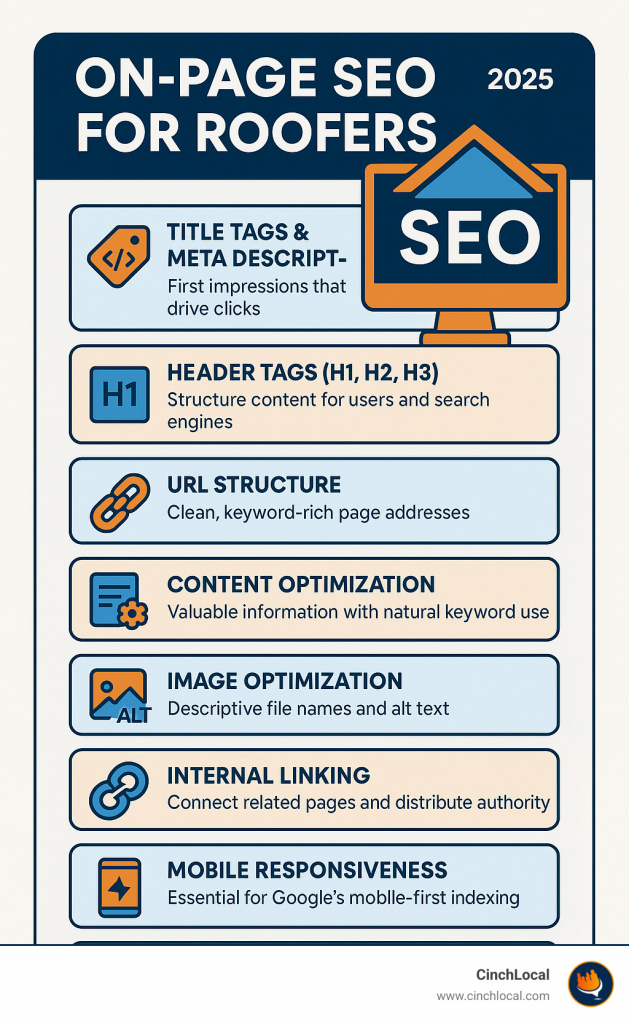
    Title Tags and CTR Optimization

    The title tag is one of the strongest onsite SEO signals because it helps both rankings and click-through rate (CTR).

    A strong title tag should:

    • include the primary keyword naturally
    • stay under about 60 characters
    • create curiosity or clear value
    • match the user’s search intent

    Weak example: Home | Services

    Better example: Local SEO Services in Michigan for Small Businesses

    Even if a page ranks well, a poor title tag can reduce traffic because users do not click. Google often measures user behavior, so stronger CTR can support better long-term performance.

    One mistake many websites make is using vague or duplicate title tags. Every important page should have a unique title that clearly explains its purpose.


    Meta Descriptions and Search Behavior

    Meta descriptions do not directly improve rankings, but they strongly influence CTR.

    Think of the meta description as a short sales pitch in search results. It should explain why the user should click your page instead of a competitor’s.

    A strong meta description should:

    • support the title tag
    • include the target keyword naturally
    • explain the value quickly
    • include a clear reason to click

    Good example: Learn proven onsite SEO strategies for higher rankings, stronger traffic, and better conversions in 2026.

    A weak description often causes users to skip your page, even if you rank on page one.


    Heading Structure and Semantic SEO

    Heading tags help both users and search engines understand content structure.

    Your page should use:

    • one H1 for the main topic
    • H2s for major sections
    • H3s for supporting details

    This improves readability and supports semantic SEO.

    Google now understands topic relationships, not just exact-match keywords. For example, an onsite SEO article should naturally include related concepts like:

    • internal linking
    • Core Web Vitals
    • schema markup
    • mobile-first indexing
    • crawl efficiency
    • topical authority

    This helps Google understand expertise without forcing keyword repetition.

    Well-structured headings also improve AI extraction because AI systems prefer clearly organized information when generating answers.


    Content Optimization and Search Intent

    Content should always match the reason behind the search.

    If someone searches “how to improve onsite SEO,” they want education and strategy. If they search “hire onsite SEO expert,” they are likely ready to convert.

    This difference matters.

    Informational intent requires:

    • guides
    • tutorials
    • blog posts
    • FAQs

    Transactional intent requires:

    • service pages
    • pricing pages
    • strong CTAs
    • trust-building content

    One common mistake is sending all traffic to one generic page. Intent mismatch leads to poor dwell time, high bounce rates, and lower rankings.

    Google rewards pages that solve the exact problem the user is trying to fix.


    Internal Linking and Authority Flow

    Internal linking is one of the most underrated onsite SEO strategies.

    It helps:

    • distribute authority across pages
    • improve crawl efficiency
    • keep users on the website longer
    • strengthen topical authority

    For example, a pillar page about SEO should link to:

    • keyword research strategies
    • local SEO best practices
    • backlink building methods
    • Google Ads optimization

    This tells Google the website has depth and expertise in the topic.

    Without strong internal linking, pages become isolated and lose ranking strength. Good websites guide both users and search engines from one relevant topic to another.


    Core Web Vitals and User Experience

    Google uses Core Web Vitals as part of ranking evaluation because speed and usability affect user satisfaction.

    Important metrics include:

    Largest Contentful Paint (LCP)

    Measures how quickly main content loads.

    Interaction to Next Paint (INP)

    Measures responsiveness when users interact.

    Cumulative Layout Shift (CLS)

    Measures visual stability while loading.

    Slow pages increase bounce rates and reduce trust. A beautiful page that loads poorly often performs worse than a simpler page with strong speed and usability.

    Businesses should optimize:

    • image compression
    • mobile performance
    • server speed
    • script management
    • layout stability

    Good SEO and good UX work together.


    Mobile-First Indexing

    Google primarily evaluates the mobile version of a website first.

    This means poor mobile design can hurt rankings even if the desktop version looks perfect.

    Strong mobile optimization includes:

    • responsive design
    • readable text sizes
    • fast loading pages
    • clear navigation
    • mobile-friendly forms
    • properly spaced buttons and CTAs

    Many users now discover businesses entirely through mobile search. If the experience feels frustrating, rankings and conversions both suffer.


    Schema Markup and GEO Optimization

    Schema markup helps search engines understand page content more clearly.

    It can support:

    • FAQs
    • reviews
    • local business information
    • products
    • services
    • events

    Schema improves visibility in rich results and helps AI-powered search systems understand trusted information faster.

    This is especially important for GEO because AI search engines often prioritize structured, easy-to-verify information when generating responses.

    For local businesses, LocalBusiness schema and FAQ schema can improve both search visibility and trust.


    KPIs to Measure Onsite SEO Success

    SEO should connect to business results, not just rankings.

    Important KPIs include:

    • organic traffic growth
    • click-through rate (CTR)
    • bounce rate
    • average session duration
    • conversion rate
    • lead generation
    • keyword ranking improvements
    • local map pack visibility
    • revenue from organic traffic

    One mistake people make is celebrating traffic increases without checking conversions. Higher rankings only matter if they support business growth.


    Common Mistakes to Avoid

    Keyword Stuffing

    Repeating the same phrase too often makes content weaker and hurts readability.

    Thin Content

    Short pages without depth rarely compete well in 2026.

    Weak Internal Linking

    Pages without strategic connections lose authority.

    Ignoring Mobile Users

    Poor mobile experience damages both rankings and trust.

    No GEO Strategy

    Ignoring AI visibility means missing future search opportunities.

    Onsite SEO must work for both Google rankings and AI-generated search answers.


    FAQ

    What is onsite SEO?

    Onsite SEO is the process of optimizing elements within your website such as content, title tags, headings, speed, and internal links to improve rankings.

    Does meta description improve rankings?

    Not directly, but it improves CTR, which can support stronger search performance.

    Why is internal linking important?

    It helps search engines understand content relationships and distributes authority across important pages.

    How do Core Web Vitals affect SEO?

    They measure speed and usability, which impact user experience and search rankings.

    What is GEO in SEO?

    GEO stands for Generative Engine Optimization and focuses on improving visibility in AI-generated search answers.


    References

    Google Search Central https://developers.google.com/search

    Google PageSpeed Insights https://pagespeed.web.dev

    Google Search Console https://search.google.com/search-console

    Semrush Blog https://www.semrush.com/blog

    Ahrefs Blog https://ahrefs.com/blog

    Moz SEO Learning Center https://moz.com/learn/seo

    Search Engine Journal https://www.searchenginejournal.com

    Backlinko SEO Guides https://backlinko.com

  • Best Methods of Doing Keyword Research in 2026

    Best Methods of Doing Keyword Research in 2026

    Introduction

    Keyword research in 2026 is no longer just about finding popular words people type into Google. Search behavior has changed significantly because users now search through Google, voice assistants, AI-powered tools, and platforms like YouTube, Reddit, and social media. Businesses must understand not only what people search for, but also why they search and how search engines interpret those queries.

    Modern keyword research combines traditional SEO with GEO (Generative Engine Optimization), semantic SEO, and user intent analysis. Google now focuses heavily on entities, topical authority, and helpful content rather than simple keyword repetition. This means businesses need deeper strategies to rank effectively.

    Strong keyword research helps improve rankings, increase qualified traffic, reduce bounce rate, and improve conversion rates. It also supports better content planning, stronger internal linking, and long-term domain authority.


    Why Traditional Keyword Research Is Not Enough

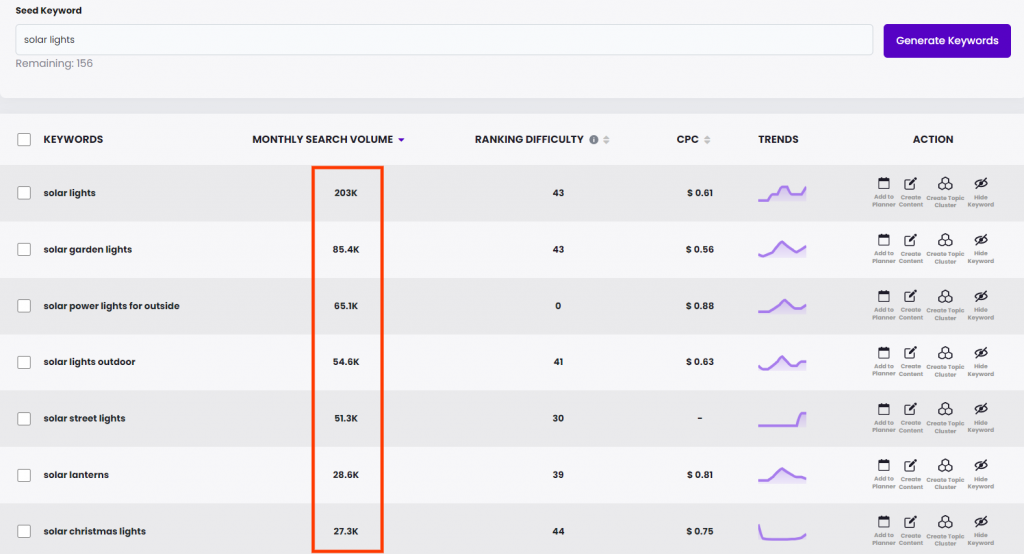
    Many beginners still rely only on search volume when choosing keywords. This approach is outdated. High-volume keywords are often extremely competitive and may not match business goals.

    For example, targeting “SEO services” may bring traffic, but targeting “local SEO services for small businesses in Michigan” brings stronger purchase intent and lower keyword difficulty.

    In 2026, successful keyword research must evaluate:

    • Search intent n- Keyword difficulty
    • Search volume
    • Conversion potential
    • SERP competition
    • AI answer visibility
    • Local search relevance
    • Topical authority opportunities

    Google and AI search engines prioritize relevance over volume. This is why long-tail and semantically connected keywords often outperform broad terms.


    Search Intent Directly Impacts Rankings

    Search intent refers to the reason behind a search query. Google ranks pages based on how well they satisfy that intent.

    There are four main types of intent:

    Informational Intent

    Users want to learn something.

    Example: “How to do keyword research”

    Best content type: Blog posts, guides, tutorials

    Navigational Intent

    Users want to reach a specific website.

    Example: “Semrush login”

    Best content type: Brand pages

    Commercial Investigation

    Users are comparing solutions.

    Example: “Best SEO tools for keyword research”

    Best content type: Comparison articles, reviews

    Transactional Intent

    Users are ready to take action.

    Example: “Hire SEO expert in Michigan”

    Best content type: Service pages, landing pages

    Intent mismatch causes poor engagement metrics like low dwell time, poor CTR, and weak rankings. Matching intent improves both SEO performance and conversion rates.


    Long-Tail Keywords Build Faster Authority

    Long-tail keywords are more specific search phrases that usually contain three or more words.

    Example:

    Short-tail: “digital marketing” Long-tail: “best digital marketing strategy for local dentists”

    Long-tail keywords are valuable because they:

    • Have lower competition
    • Match stronger user intent
    • Convert better
    • Support local SEO
    • Align with AI-driven conversational search

    AI search engines prefer natural language queries because they reflect how people actually ask questions. This makes long-tail keywords even more important in 2026.

    For newer websites, long-tail strategies help establish topical authority faster than competing for broad national keywords.


    Keyword Clustering and Topical Authority

    Instead of writing one page for one keyword, modern SEO uses keyword clustering.

    Keyword clustering means grouping related keywords around one main topic.

    Example cluster: Main Topic: Local SEO

    Supporting keywords:

    • local SEO strategy
    • Google Business Profile optimization
    • local SEO ranking factors
    • local citations
    • map pack optimization

    This helps search engines understand subject expertise and improves internal linking opportunities.

    Google rewards topical authority because it signals trust and expertise. One strong pillar page supported by multiple cluster articles performs better than isolated blog posts.

    This strategy also improves GEO visibility because AI systems prefer citing trusted topical sources.


    Semantic SEO and Entity Optimization

    Google now understands relationships between concepts, not just exact-match keywords.

    This is called semantic SEO.

    For example, an article about keyword research should naturally include related concepts like:

    • search intent
    • SERP analysis
    • keyword difficulty
    • ranking factors
    • topical authority
    • content mapping
    • internal linking
    • conversion optimization

    These supporting terms help search engines understand expertise.

    Entity SEO focuses on recognized topics, brands, places, and concepts. For example:

    • Google Analytics 4 n- Google Search Console
    • Semrush
    • Ahrefs
    • Michigan local businesses

    Using strong semantic relationships improves both traditional rankings and AI answer extraction.


    Best Tools for Keyword Research in 2026

    Google Search Console

    Best for understanding real search queries already bringing traffic.

    Use for:

    • CTR analysis
    • impression tracking
    • ranking opportunities
    • page optimization

    Google Keyword Planner

    Best for PPC and baseline keyword ideas.

    Use for:

    • search volume
    • keyword forecasting
    • commercial intent research

    Semrush

    Best for competitor gap analysis.

    Use for:

    • keyword difficulty
    • ranking gaps
    • domain comparison
    • backlink overlap

    Ahrefs

    Best for content strategy and backlink analysis.

    Use for:

    • keyword opportunities
    • link authority research
    • competitor content mapping

    Google Trends

    Best for trend forecasting.

    Use for:

    • seasonal demand
    • emerging search behavior
    • regional search patterns

    The best strategy uses multiple tools together rather than relying on only one platform.


    Metrics and KPIs to Track

    Keyword research should connect to measurable business outcomes.

    Important KPIs include:

    • Organic traffic growth
    • Click-through rate (CTR)
    • Conversion rate
    • Bounce rate
    • Average ranking position
    • Qualified lead generation
    • Local map pack visibility
    • Revenue from organic traffic

    Example: A keyword with lower traffic but a 7% conversion rate is often more valuable than a high-volume keyword with low buying intent.

    SEO should support revenue, not just rankings.


    Common Mistakes to Avoid

    Choosing Keywords Only by Volume

    High traffic does not always mean high value.

    Ignoring Search Intent

    Wrong page type leads to poor rankings.

    Weak Internal Linking

    Pages without strategic internal links lose authority flow.

    No Competitor Analysis

    You must understand what already ranks before creating content.

    No GEO Strategy

    Ignoring AI search visibility reduces future search opportunities.

    Keyword research must support both Google rankings and AI-generated answer systems.


    FAQ

    What is the best keyword research tool in 2026?

    There is no single best tool. Google Search Console, Semrush, Ahrefs, and Google Keyword Planner work best when used together.

    Are long-tail keywords better than short-tail keywords?

    For newer websites, yes. Long-tail keywords usually have lower competition and stronger conversion intent.

    How does AI affect keyword research?

    AI search engines prioritize natural language, semantic relevance, and trusted topical authority rather than exact-match keyword repetition.

    What is keyword clustering?

    Keyword clustering is grouping related keywords under one main topic to improve topical authority and internal linking strength.

    Why is search intent important?

    Because Google ranks pages based on how well they satisfy the user’s purpose behind the search.


    References

    Google Search Central https://developers.google.com/search

    Google Keyword Planner https://ads.google.com

    Semrush Blog https://www.semrush.com/blog

    Ahrefs Blog https://ahrefs.com/blog

    Moz SEO Learning Center https://moz.com/learn/seo

    Search Engine Journal https://www.searchenginejournal.com
    HubSpot Marketing Blog https://blog.hubspot.com

    Backlinko SEO Guides https://backlinko.com