Introduction
Programmatic display advertising in 2026 is much more than placing banner ads across websites. It has become a highly data-driven strategy that helps businesses reach the right audience at the right time with the right message. Instead of manually buying ad placements, advertisers now use automated systems that make real-time decisions based on user behavior, audience signals, and campaign goals.
As privacy rules continue to change and third-party cookies become less reliable, marketers must rely more on first-party data, contextual targeting, and stronger audience segmentation. Programmatic advertising is no longer just about impressions—it is about precision, efficiency, and measurable business results.
When done correctly, programmatic campaigns improve brand awareness, lower customer acquisition costs, support retargeting strategies, and create stronger full-funnel marketing performance. In 2026, success depends on strategy, not just automation.
Why Programmatic Advertising Matters More in 2026
Many people think programmatic advertising is simply automated banner ads, but that view is too basic. Today, programmatic supports display, video, connected TV (CTV), audio, mobile apps, and even digital out-of-home advertising.
The biggest advantage is efficiency. Instead of buying broad placements and hoping the right people see them, advertisers can target users based on behavior, interests, demographics, location, and intent signals.
For example, a healthcare business promoting a new service can target users who recently searched related topics, visited competitor websites, or interacted with healthcare content online.
This improves:
- ad relevance
- click-through rate (CTR)
- conversion rate
- return on ad spend (ROAS)
- customer acquisition efficiency
Programmatic works best when targeting supports business goals rather than chasing impressions alone.
First-Party Data and Privacy-Focused Targeting
One of the biggest shifts in 2026 is the move away from third-party cookies.
Because of privacy regulations and browser restrictions, advertisers now depend more on first-party data. This includes information collected directly from customers through websites, CRM systems, email lists, app activity, and loyalty programs.
First-party data is stronger because it is:
- more accurate
- privacy-safe
- based on real customer behavior
- easier to connect to conversions
For example, an ecommerce brand can use purchase history and abandoned cart behavior to create stronger retargeting campaigns.
This creates better personalization without depending on outside data providers.
The future of programmatic is built on owned audience data, not borrowed data.
Audience Segmentation and Intent-Based Targeting
Strong targeting starts with understanding audience intent.
Not every user is at the same stage of the customer journey. Some are discovering a problem, while others are ready to buy.
Good audience segmentation usually includes:
Awareness Stage
Users learning about a problem.
Best strategy: Educational display ads, video ads, CTV awareness campaigns
Consideration Stage
Users comparing solutions.
Best strategy: Comparison messaging, product benefits, review-focused creative
Conversion Stage
Users ready to take action.
Best strategy: Retargeting, offer-based ads, strong CTA messaging
Intent-based targeting improves both engagement and conversion efficiency because the message matches the user’s actual need.
Sending the same ad to every audience usually wastes budget.
Retargeting and Conversion Efficiency
Retargeting is one of the strongest parts of programmatic advertising because it focuses on users who already showed interest.
Examples include users who:
- visited a landing page
- added products to cart
- watched product videos
- downloaded a guide
- clicked an earlier ad
These users are much closer to converting than cold traffic.
A common mistake is retargeting too aggressively. Showing the same ad too many times creates ad fatigue and damages brand trust.
This is why frequency capping matters.
Frequency capping limits how often the same person sees an ad, helping protect budget and improve user experience.
Retargeting should feel helpful, not repetitive.
DSPs, SSPs, and Real-Time Bidding Strategy
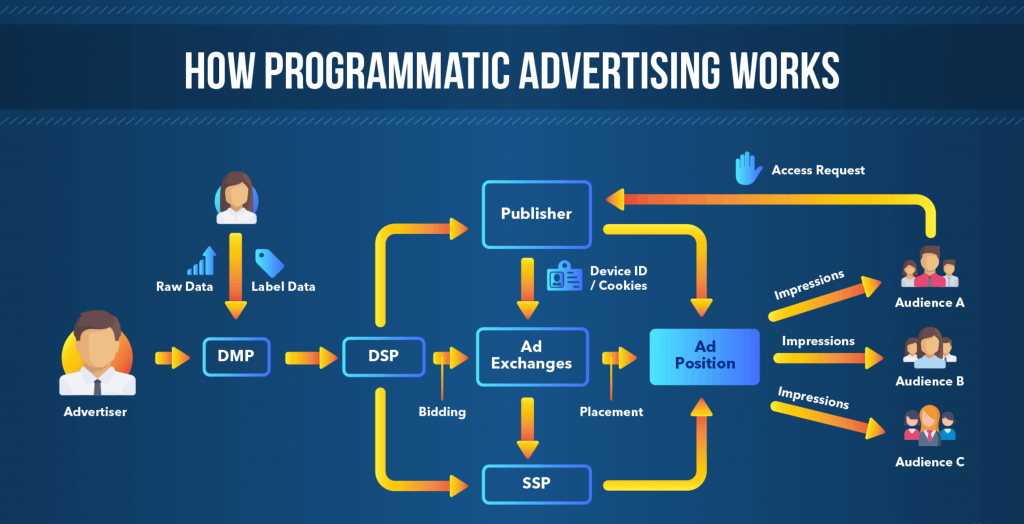
Programmatic advertising runs through platforms called DSPs and SSPs.
DSP (Demand-Side Platform)
Used by advertisers to buy ad inventory.
Examples include platforms like Google Display & Video 360 and The Trade Desk.
SSP (Supply-Side Platform)
Used by publishers to sell available ad space.
These platforms connect through real-time bidding (RTB), where ad impressions are bought and sold in milliseconds.
The system evaluates:
- audience match
- bid amount
- ad quality
- relevance
- campaign objectives
The advertiser with the strongest combined value wins the placement.
This process allows advertisers to spend more efficiently instead of paying flat placement fees.
CTV and Full-Funnel Strategy
Connected TV (CTV) has become one of the fastest-growing parts of programmatic advertising.
CTV includes streaming platforms where ads run during digital television viewing.
CTV is powerful because it combines:
- strong visual storytelling
- high attention rates
- household targeting
- measurable digital performance
A strong strategy often uses CTV for awareness and display retargeting for conversion.
For example:
Step 1: User sees a CTV ad on streaming TV
Step 2: Later, they receive display retargeting ads on mobile or desktop
Step 3: They return and convert
This creates stronger full-funnel performance than relying on one channel alone.
Creative Optimization and Dynamic Creative
Even strong targeting fails if the creative is weak.
Creative should match both audience intent and placement type.
Dynamic creative optimization (DCO) allows advertisers to automatically adjust headlines, visuals, offers, and CTAs based on user behavior.
For example:
- new visitors may see educational messaging
- returning visitors may see stronger offers
- abandoned cart users may see urgency messaging
This improves relevance and often increases CTR and conversion rates.
Programmatic success depends on both data and creative working together.
Brand Safety and Fraud Prevention
Not every impression is valuable.
Advertisers must protect campaigns from poor placements, invalid traffic, and ad fraud.
Important protections include:
- brand safety filters
- fraud detection tools
- viewability monitoring
- approved publisher lists
- content category exclusions
Without these controls, brands may waste budget or appear next to harmful content that damages trust.
Good targeting should also protect reputation, not just performance.
KPIs That Actually Measure Performance
Programmatic campaigns should be measured by business outcomes, not impressions alone.
Important KPIs include:
- click-through rate (CTR)
- conversion rate
- cost per acquisition (CPA)
- return on ad spend (ROAS)
- view-through conversions
- frequency
- customer acquisition cost (CAC)
- audience reach quality
- assisted conversions
One mistake many marketers make is focusing only on clicks. Some display campaigns create strong brand lift and assisted conversions even when direct click volume looks low.
Measurement should reflect the full customer journey.
Common Mistakes to Avoid
Chasing Impressions Instead of Outcomes
High reach means little if conversions stay weak.
Poor Audience Segmentation
Broad targeting often wastes budget.
Ignoring Frequency Capping
Too much repetition creates ad fatigue.
Weak Creative Strategy
Good targeting cannot save poor messaging.
No First-Party Data Plan
Relying only on third-party signals is risky in 2026.
Programmatic strategy should focus on precision, not just automation.
FAQ
What is programmatic display advertising?
Programmatic display advertising uses automated platforms to buy and place digital ads based on audience targeting and real-time bidding.
Why is first-party data important?
It provides more accurate targeting and supports privacy-safe marketing as third-party cookies decline.
What is frequency capping?
It limits how often the same person sees an ad to reduce ad fatigue and protect campaign performance.
How does CTV support programmatic advertising?
CTV helps build awareness through streaming platforms and works well with display retargeting for full-funnel strategy.
What is the difference between a DSP and SSP?
A DSP helps advertisers buy ad space, while an SSP helps publishers sell available inventory.
References
Google Display & Video 360 https://marketingplatform.google.com
The Trade Desk Resources https://www.thetradedesk.com
Google Ads Help Center https://support.google.com/google-ads
IAB (Interactive Advertising Bureau) https://www.iab.com
Search Engine Journal https://www.searchenginejournal.com
HubSpot Marketing Blog https://blog.hubspot.com
Semrush Blog https://www.semrush.com/blog
Backlinko Marketing Guides https://backlinko.com
Leave a Reply