Introduction
Google Ads bidding in 2026 is no longer just about setting a maximum cost-per-click and hoping for the best. Today, bidding strategies are heavily driven by machine learning, real-time auction signals, and conversion quality. Businesses that choose the wrong bidding strategy often waste budget, attract low-quality leads, and struggle to improve return on investment (ROI).
The goal of bidding is not simply to get more clicks. The real goal is to generate profitable conversions while controlling acquisition costs. This means advertisers must understand how Smart Bidding works, how conversion tracking affects performance, and how first-party data improves optimization.
Whether the goal is lead generation, ecommerce sales, local traffic, or brand visibility, bidding strategy directly impacts campaign success. In 2026, better ROI comes from strategy, not just higher bids.
Why Bidding Strategy Matters More in 2026
Many advertisers still focus too much on CPC and average position, but those metrics alone do not tell the full story.
Google now uses auction-time bidding, meaning Smart Bidding strategies evaluate every single search auction in real time. The system looks at dozens of signals such as:
- device type
- location
- time of day
- search intent
- audience behavior
- remarketing history
- browser and operating system
- previous conversion patterns
This allows Google to adjust bids differently for every user instead of using one fixed bid.
For example, someone searching “emergency dentist near me” at 10 PM may be far more valuable than someone casually searching “dental care tips” during lunch.
The stronger the strategy, the stronger the efficiency.
Manual Bidding vs Smart Bidding
Manual bidding gives advertisers full control over maximum CPC bids. This can work for small campaigns or when testing new accounts, but it often limits scale because it cannot react to real-time auction signals.
Smart Bidding uses Google AI to automatically adjust bids based on conversion goals.
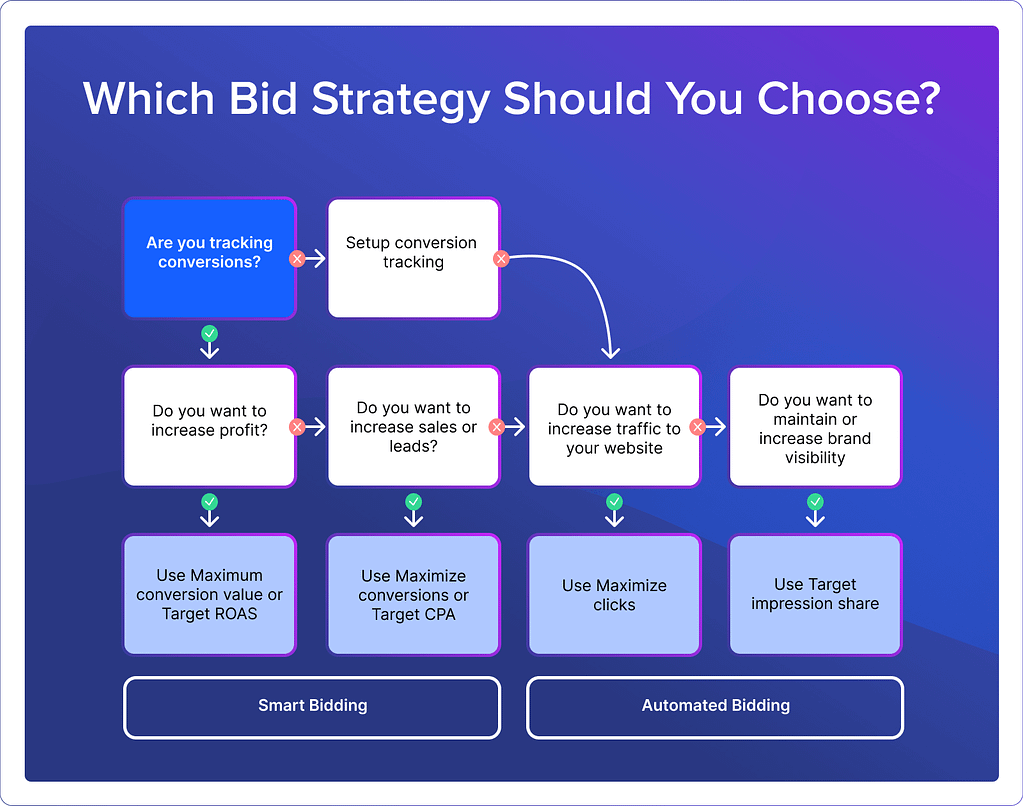
Common Smart Bidding strategies include:
- Target CPA
- Target ROAS
- Maximize Conversions
- Maximize Conversion Value
- Target Impression Share
Most mature campaigns perform better with Smart Bidding because the system can process more signals than a human can manage manually.
However, Smart Bidding only works well when conversion tracking is accurate.
Automation without clean data creates expensive mistakes.
How Smart Bidding Uses Auction-Time Signals
One reason Smart Bidding is powerful is auction-time bidding.
Instead of setting one bid for all searches, Google evaluates every auction individually.
For example:
A user searching from a high-income ZIP code on mobile during business hours may receive a higher bid than a user searching late at night from a lower-converting region.
This improves efficiency because budget is pushed toward users with stronger conversion probability.
Google’s algorithm also learns from historical conversion data, audience behavior, and account performance trends.
This is why frequent strategy changes can hurt performance. The system needs stable learning periods to optimize correctly.
Target CPA vs Target ROAS
These two strategies are often confused, but they solve different business problems.
Target CPA (Cost Per Acquisition)
Best for lead generation businesses where each lead has similar value.
Example:
A local law firm or dental office generating consultation requests.
Goal: Control average cost per lead.
Target ROAS (Return on Ad Spend)
Best for ecommerce or businesses where conversions have different values.
Example:
An online store selling products with different prices.
Goal: Maximize revenue efficiency.
Choosing the wrong strategy creates poor optimization.
If conversion value matters, CPA alone is too limited.
If lead quality matters more than revenue value, ROAS may not be the right choice.
Maximize Conversions vs Maximize Conversion Value
These strategies also require strategic thinking.
Maximize Conversions
Focuses on getting the highest number of conversions within budget.
Best for:
- lead generation
- local services
- appointment bookings
Maximize Conversion Value
Focuses on maximizing total revenue value rather than conversion count.
Best for:
- ecommerce
- high-ticket sales
- revenue-based optimization
A campaign with fewer high-value conversions can be stronger than one with many low-quality leads.
Volume should never be confused with profitability.
Conversion Tracking and Data Quality
Smart Bidding is only as good as the data it receives.
If conversion tracking is weak, the algorithm optimizes for the wrong outcomes.
Examples of poor tracking include:
- counting all form submissions equally
- missing phone call conversions
- tracking low-value page views as conversions
- duplicate conversion actions
- delayed offline sales not connected to campaigns
For example, if a business tracks every contact form equally, Google may optimize for spam leads instead of qualified prospects.
Better conversion tracking creates better bidding decisions.
The algorithm needs clear signals, not noise.
First-Party Data and Enhanced Conversions
In 2026, first-party data is becoming more important because privacy changes reduce tracking accuracy.
Enhanced conversions improve measurement by using secure first-party customer data like email addresses and form submissions to improve attribution accuracy.
This helps Google better understand:
- which leads become real customers
- which campaigns drive revenue
- which audiences convert best
Businesses using CRM integration and offline conversion imports often see stronger Smart Bidding performance because Google can optimize toward real business outcomes instead of shallow conversion events.
Good bidding strategy starts with better data.
Broad Match and Smart Bidding Strategy
Broad match keywords used to have a bad reputation, but in 2026 they work much better when paired with Smart Bidding.
Broad match allows Google to reach searches that may not match exact phrasing but still show strong intent.
Example:
Keyword: local SEO services
Possible matching search: help my business rank on Google Maps
When combined with Smart Bidding, broad match helps advertisers capture valuable searches they may otherwise miss.
The key is strong conversion tracking and clear bidding goals.
Broad match without strategy can waste budget. Broad match with Smart Bidding can unlock scale.
Budget Pacing and Learning Periods
One mistake many advertisers make is changing budgets too often.
Smart Bidding needs time to learn.
Frequent changes to:
- budgets
- targets
- bid strategies
- campaign structure
can reset the learning phase and reduce performance.
A campaign should usually have enough budget to support at least 10–15 conversions per month for stable optimization, though stronger learning often happens with higher volume.
Patience is part of performance.
Constant manual interference often hurts ROI more than it helps.
KPIs That Actually Measure ROI
Good bidding strategy should be measured by business outcomes, not vanity metrics.
Important KPIs include:
- conversion rate
- cost per acquisition (CPA)
- return on ad spend (ROAS)
- lead quality
- customer acquisition cost (CAC)
- lifetime value (LTV)
- impression share
- assisted conversions
- qualified revenue from paid search
A common mistake is celebrating low CPC while ignoring weak lead quality.
Cheap clicks are not valuable if they do not turn into revenue.
ROI always matters more than traffic volume.
Common Mistakes to Avoid
Choosing Strategy Too Early
New campaigns often need data before advanced bidding strategies work well.
Weak Conversion Tracking
Bad data creates bad automation.
Frequent Budget Changes
This disrupts algorithm learning.
Ignoring Lead Quality
Not every conversion is equally valuable.
Focusing Only on CPC
Lower CPC does not always mean better profitability.
Google Ads should optimize for business growth, not just cheaper clicks.
FAQ
What is Smart Bidding in Google Ads?
Smart Bidding uses Google AI to automatically adjust bids based on conversion goals and auction-time signals.
When should I use Target CPA?
Use Target CPA when most conversions have similar value, such as lead generation or appointment bookings.
When is Target ROAS better?
Use Target ROAS when conversion values vary, especially in ecommerce or revenue-focused campaigns.
Why are enhanced conversions important?
They improve attribution accuracy using first-party data and help Smart Bidding optimize toward better leads.
Does broad match work well in 2026?
Yes, when paired with Smart Bidding and strong conversion tracking, broad match can improve scale and reach valuable search traffic.
References
Google Ads Help Center https://support.google.com/google-ads
Google Smart Bidding Guide https://support.google.com/google-ads/answer/7065882
Google Ads Enhanced Conversions https://support.google.com/google-ads
Search Engine Journal https://www.searchenginejournal.com
Semrush Blog https://www.semrush.com/blog
HubSpot Marketing Blog https://blog.hubspot.com
Backlinko PPC Guides https://backlinko.com
WordStream PPC Resources https://www.wordstream.com
Leave a Reply